USAID DEC
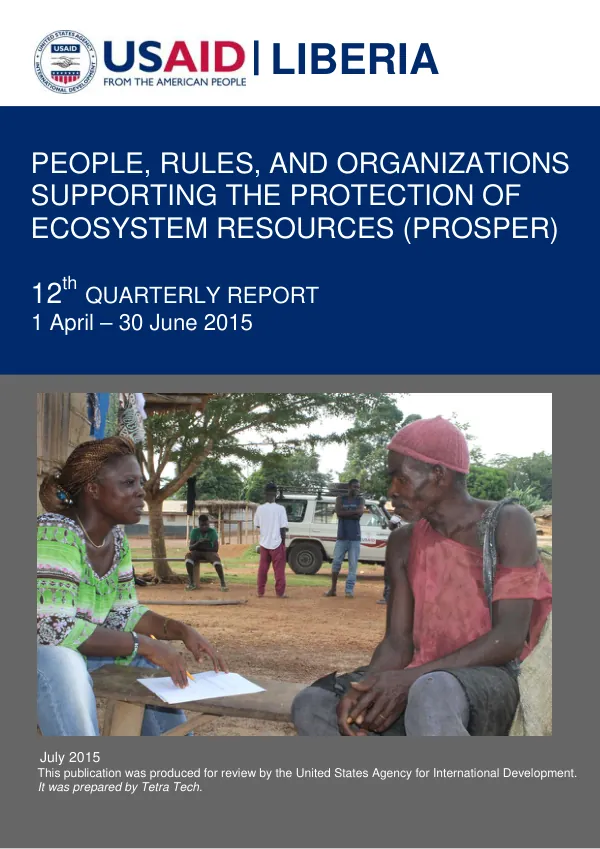
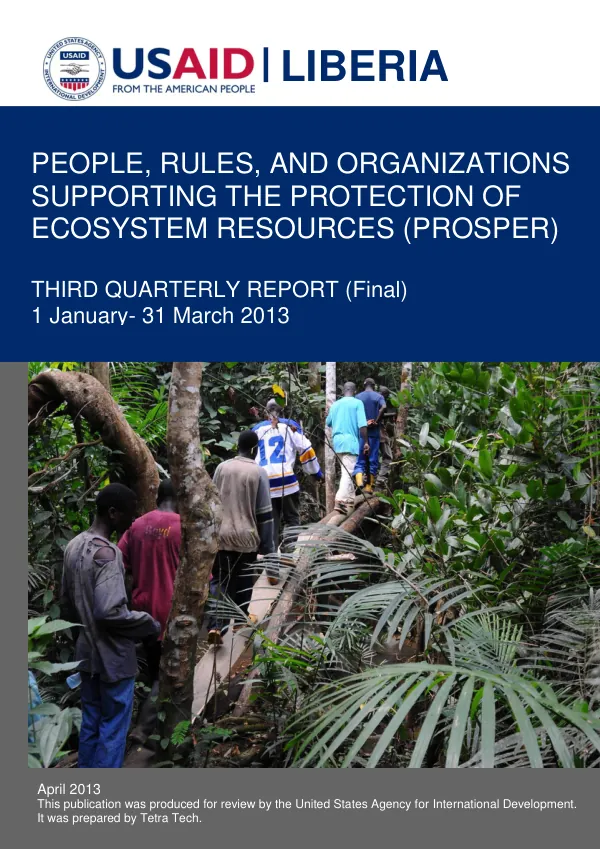
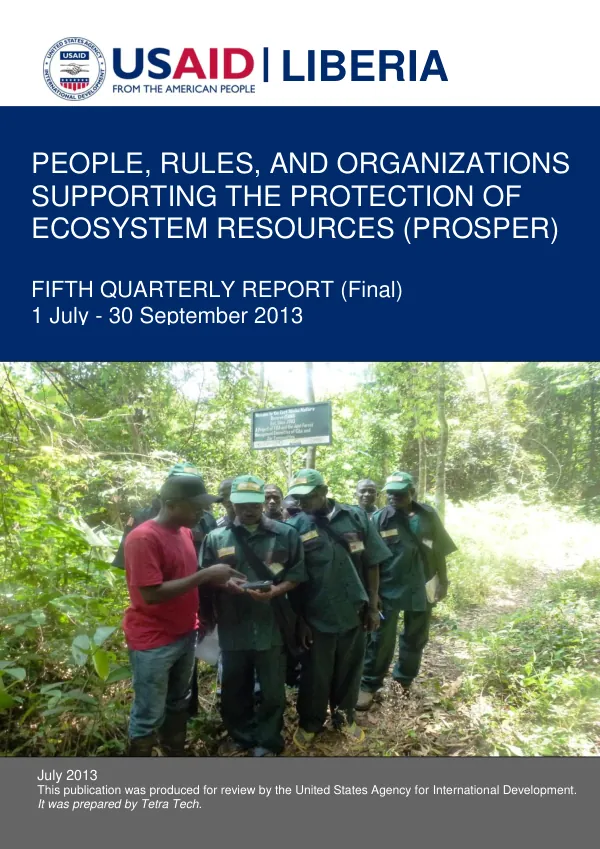
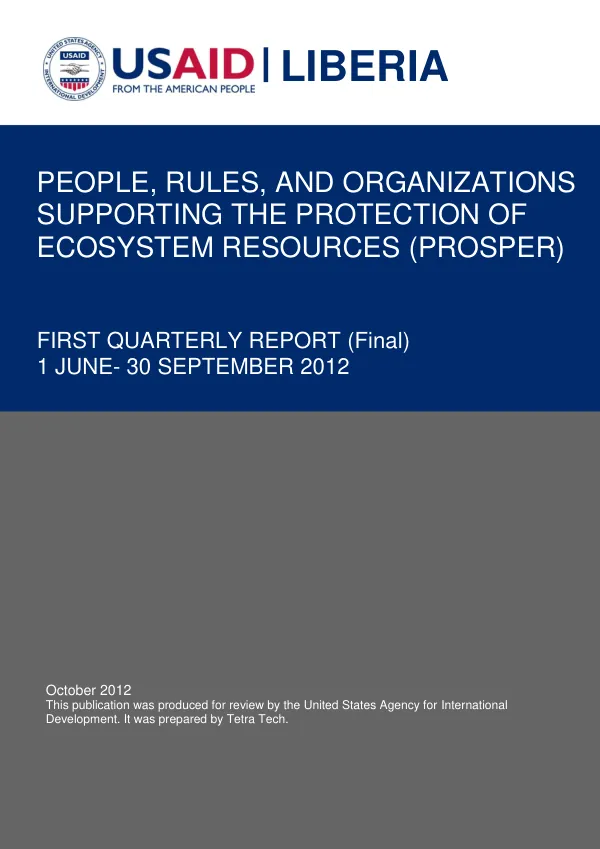
First Quarterly Report: People, Rules, and Organizations Supporting the Protection of Ecosystem Resources (PROSPER) Program
Sign inTETRA TECH
First Quarterly Report: People, Rules, and Organizations Supporting the Protection of Ecosystem Resources (PROSPER) Program
The PROSPER program, implemented by Tetra Tech, aims to introduce, operationalize, and refine models for community management of forest resources for local self-governance and enterprise development in targeted areas of Liberia.
2012 · 31 pages
Sign in to readA free account is required to download.
Abstract
The program's overall goal is to promote sustainable forest management and biodiversity conservation. The three primary objectives of the program are to expand educational and institutional capacity, improve community-based forest management, and enhance community-based livelihoods derived from sustainable forest-based and agriculture-based enterprises. The program's implementation began in June 2012, with the installation of the core technical and administrative team, including 10 host country staff and expatriate Chief of Party, Deputy Chief of Party/Component 2 Leader, and Component 1 Leader. Tetra Tech took over the lease on the Liberia Forestry Support Program (LFSP) field office in northern Nimba and maintained the staff, allowing support of the three community forestry sites in Nimba to continue without interruption. During the four-month mobilization period, PROSPER organized an Inception Workshop for project staff, implementing partners, and key government and civil society stakeholders. The workshop resulted in the definition of a work plan, approved by USAID, covering the mobilization period. The program worked with community forest management bodies and partners in its "inherited" sites in Northern Nimba and the East Nimba Nature Reserve to consolidate and deepen results achieved under the Land Rights and Community Forestry Program (LRCFP) and the Liberia Forestry Support Program (LFSP). Subcontracts were signed in June with PROSPER's three national subcontractors, allowing them to field staff to Northern Nimba. In September, following USAID's approval of seven new proposed work sites, PROSPER team members took to the field to inform the communities of their selection and to initiate community profiling. In parallel, with the support of subcontractors Fauna and Flora International (FFI), ASNAPP, and Rutgers University, PROSPER launched biodiversity assessments, ethno-botanical surveys, and value chain analyses in the new sites. The major activities and results assigned to the Education and Outreach, Community Forestry, and Livelihoods components under the mobilization plan were largely completed, with the notable exception of PROSPER's planned support to the Forestry Training Institute to conduct a gap analysis of the curriculum. The Component 1 team deferred this activity due to stretched resources in August and September. The program's work plan for the mobilization period included several important cross-cutting activities, such as site selection, gender assessment, performance monitoring plan development, and work planning. These activities were undertaken to ensure a smooth transition from the previous program and to lay the foundation for the program's future activities. The PROSPER program's implementation has been marked by a period of intense preparation and initiation of activities. The program has worked closely with community forest management bodies and partners to consolidate and deepen results achieved under previous programs. The program's future activities will focus on implementing the work plan and achieving the program's objectives. The program's geographic focus is on targeted areas of Liberia, with a specific emphasis on Northern Nimba and the East Nimba Nature Reserve. The program's timeframes are from June 2012 to September 2012, with a five-year program duration from 2012 to 2017. The program's recommendations are to continue implementing the work plan and to ensure a smooth transition to the next phase of the program. The program's implementation has been supported by several subcontractors, including Fauna and Flora International (FFI), ASNAPP, and Rutgers University. These subcontractors have provided technical assistance and support to the program, including biodiversity assessments, ethno-botanical surveys, and value chain analyses. The program's major challenges and obstacles include the need to ensure a smooth transition from the previous program and to lay the foundation for the program's future activities. The program's team has worked closely with community forest management bodies and partners to address these challenges and to ensure the program's success.
Related documents