USAID
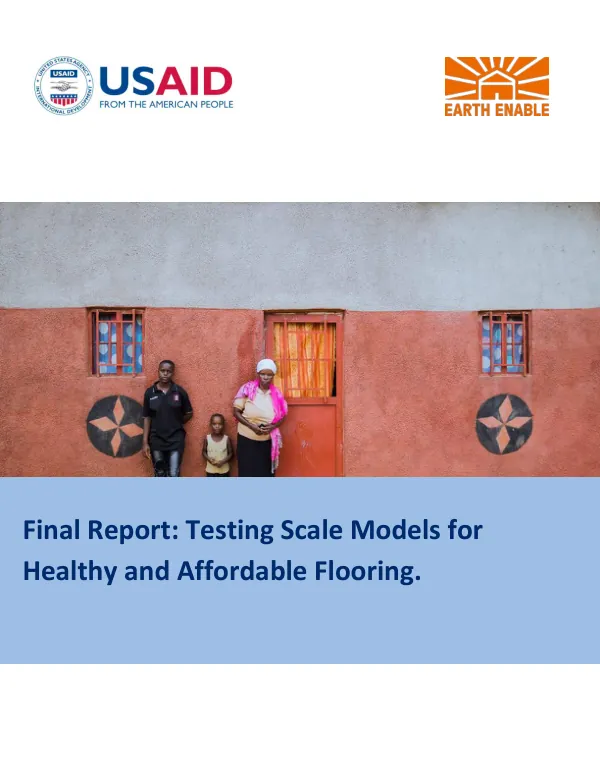
Final Report: Testing Scale Models for Healthy and Affordable Flooring
EarthEnable, a non-profit organization, has made significant progress in providing clean, durable, and affordable flooring to rural families living in poverty.
2023 · 117 pages
Sign in to readA free account is required to download.
Abstract
The organization's core objective of replacing dirt floors with healthier alternatives remained unchanged throughout the project. EarthEnable's previous model involved selling floors, transporting materials to construction sites, and employing masons to build floors. However, the organization has since adopted a micro-franchise model, empowering community-based masons to become earthen construction entrepreneurs and independently build housing products in their communities. The project's main goals were to assess the health impact, organically expand, and experiment and test different scale models in Rwanda, Uganda, and other countries. EarthEnable successfully implemented its micro-franchise model across Rwanda and Eastern Uganda, scaling from 5 districts in 2018 to 38 districts in 2022. The organization also piloted master franchising in Western Uganda and Western Kenya. Evaluation efforts were carried out with a Randomized Controlled Trial (RCT) that had three phases: Phase 1 (House Identification), Phase 2 (Biological Plausibility Study), and Phase 3 (Behavioral Change). Findings from the Biological Plausibility Study demonstrated that improved flooring can reduce children's exposure to dust indoors and reduce re-infection with hookworms. Between 2018 and 2022, EarthEnable positively transformed the living conditions of 18,533 households and 2,862 Early Childhood Development centers, benefiting 132,953 individuals, including 51,320 children. The organization also developed new housing products, such as earthen plaster and improved adobe blocks, and adapted its products to new contexts. Additionally, EarthEnable introduced financing options, such as working with cooperatives and microfinance institutions, to make its housing products more accessible. EarthEnable's flagship flooring product is 80% more affordable and emits 96% less CO2 compared to concrete. The organization has also piloted an affordable and sustainable full house for families living in extremely unsafe and unhealthy housing conditions that require a holistic housing solution. Looking ahead, EarthEnable plans to leverage its momentum to catalyze an affordable and sustainable earthen housing industry in Africa. The organization aims to scale to new geographical contexts, form strategic partnerships, and train more local masons into earthen construction entrepreneurs. The project's evaluation efforts were carried out with a Randomized Controlled Trial (RCT) that had three phases: Phase 1 (House Identification), Phase 2 (Biological Plausibility Study), and Phase 3 (Behavioral Change). Phase 1 and Phase 2 were completed, and findings from the Biological Plausibility Study demonstrated that improved flooring can reduce children's exposure to dust indoors and reduce re-infection with hookworms. Phase 3 was disrupted by COVID-19 and was not completed; however, qualitative behavioral change findings from another study demonstrated a positive behavior change associated with improved flooring. EarthEnable's fiscal year organizational target was to impact 115,773 people between 2018 and 2022. Over this period, the organization transformed the living conditions for 18,553 households and 2,566 Early Childhood Development centers, positively impacting 132,953 people, including 51,320 children in ECDs. The organization's next steps include scaling to new geographical contexts, forming and solidifying strategic partnerships, and training more local masons into earthen construction entrepreneurs.