USAID DEC
Final Report: Special Programs to Address the Needs of Survivors (SPANS) Grant Solicitation and Management (GSM)
Sign inUSAID
Final Report: Special Programs to Address the Needs of Survivors (SPANS) Grant Solicitation and Management (GSM)
The Special Programs to Address the Needs of Survivors (SPANS) Grant Solicitation and Management (GSM) project was a grantmaking initiative funded through a Cooperative Agreement with the United States Agency for International Development (USAID).
2018 · 34 pages
Sign in to readA free account is required to download.
Abstract
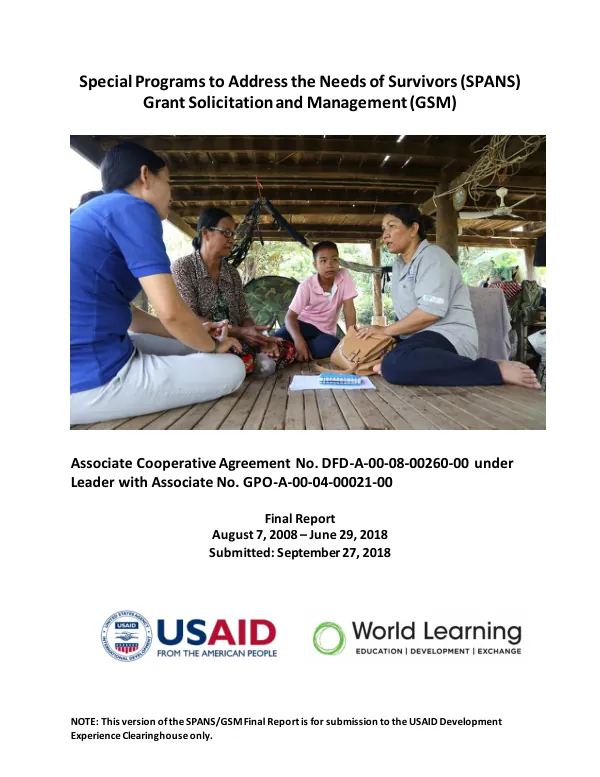
The project was implemented from August 7, 2008 to June 29, 2018, and was funded under Associate Award (No. DFD-A-00-08-00260-00) under the Leader with Associate Award Grant Solicitation and Management (No. GPO-A-00-04-00021-00). The purpose of the SPANS/GSM mechanism was to support USAID's goal of improving the health and wellbeing of specific vulnerable populations, including displaced children and orphans, war victims, people with disabilities, and victims of torture. Through SPANS/GSM, service delivery, training, and related activities aimed at assisting vulnerable populations worldwide were funded through the grants program. USAID also utilized the mechanism to issue contracts for procurement of goods and services. World Learning worked closely with USAID's Empowerment and Inclusion (EI) Division in the Bureau for Democracy, Conflict, and Humanitarian Assistance (DCHA) to provide more than $47 million in grants to non-governmental organizations (NGOs) throughout the world. A total of 36 grants were awarded under SPANS/GSM as a result of 10 Request for Applications (RFAs) issued by World Learning on behalf of EI's portfolio comprised of five congressionally mandated funds: Displaced Children and Orphan's Fund (DCOF), Leahy War Victims Fund (LWVF), Victims of Torture Fund (VOT), Wheelchair Program, and the Disability Program. The SPANS/GSM mechanism was designed to provide quality support to USAID and its grantees. The project implemented an efficient and cost-effective grants management model that enabled the provision of quality services to vulnerable and marginalized populations. The project also increased co-creation activities and shared learning among stakeholders, which contributed to improved access to quality services for vulnerable populations. The project's results include the implementation of an effective grantmaking mechanism that contributed to improved access to quality services for vulnerable and marginalized populations. The project also increased co-creation activities and shared learning among stakeholders, which contributed to improved access to quality services for vulnerable populations. Additionally, the project strengthened the capacity of partner organizations to provide quality services to vulnerable populations. The project's geographic focus was worldwide, with grants awarded to NGOs in 43 countries. The project's timeframes were from August 7, 2008 to June 29, 2018, during which time the project disbursed more than $47 million in grant funds. The project's recommendations for future programming include the continued support of vulnerable populations and the strengthening of partner organizations' capacity to provide quality services. The project's lessons learned and best practices include the importance of collaboration and co-creation among stakeholders, the need for effective grants management, and the importance of capacity development for partner organizations. The project's recommendations for future programming include the continued support of vulnerable populations and the strengthening of partner organizations' capacity to provide quality services.
Related documents