UNITED NATIONS CHILDREN'S FUND
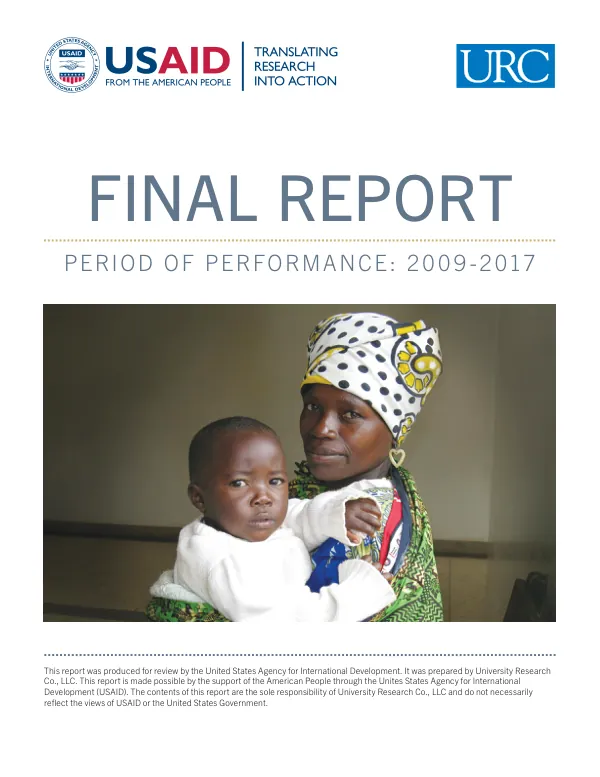
Final Report: Translating Research into Action (TRAction) Project
The Translating Research into Action (TRAction) Project was a technical assistance program launched in 2009 by University Research Co., LLC (URC) in collaboration with the Harvard School of Public Health.
2017 · 79 pages
Sign in to readA free account is required to download.
Abstract
The project aimed to contribute to the advancement of Implementation Science (IS) to improve Maternal, Neonatal and Child Health (MNCH), Family Planning and Reproductive Health, and other related health challenges. TRAction focused on advancing IS to provide critically needed evidence to program implementers and policymakers. The project's overarching goal was to advance the science required to scale-up evidence-based interventions proven to reduce mortality and severe morbidity among women, newborns, and young children. TRAction used two principal approaches to advance the field of IS: applying IS to real-world, complex MNCH problems to provide a deeper understanding of the issues and potential solutions, and working to advance the profile of IS/Implementation Research and Delivery Science (IRDS) in the overall global health agenda from both policy and program perspectives. During the life of the project, TRAction conducted studies in 20 countries on 15 topics, presented at 34 conferences, published 27 articles, and worked with 49 partners, 22 of which were in low to middle-income countries (LMICs). Major areas of study included respectful maternal care, equitable healthcare access, illness recognition and care seeking for maternal and newborn complications, integrated community case management, human resources for health, malaria, community management of unclassified fever, household air pollution (HAP), and water, sanitation, and hygiene (WASH). TRAction used five overarching strategies to accomplish its goals: global level financing for research studies, which involved developing requests for proposals (RFPs) and peer-reviewed technical submissions to identify, finance, and support sub-awards to implementing agencies, universities, and research institutions to design and manage research studies in key areas of IS. The project's global level financing efforts were geared toward identifying priority MNCH agenda questions and research teams, engaging outside technical and programmatic reviewers as a means of leveraging expertise for the project, and producing results that through targeted dissemination efforts can place critical evidence into the hands of program implementers and policymakers. TRAction's work focused on advancing the science required to scale-up evidence-based interventions proven to reduce mortality and severe morbidity among women, newborns, and young children. The project's findings and recommendations were intended to inform policy and program decisions at the global, national, and local levels, with the ultimate goal of improving health outcomes for vulnerable populations.