USAID DEC
Final Report: USAID Regional Program for the Management of Aquatic Resources and Economic Alternatives in Honduras
Sign inUSAID
Final Report: USAID Regional Program for the Management of Aquatic Resources and Economic Alternatives in Honduras
The USAID Regional Program for the Management of Aquatic Resources and Economic Alternatives (MAREA) aims to reduce the threats posed by unsustainable fishing practices, laying the foundations for a rights-based mechanism to strengthen management of coastal and marine resources, conserve and protect critical marine biodiversity, and improve the livelihoods of those who rely on marine resources in Central America.
2013 · 74 pages
Sign in to readA free account is required to download.
Abstract
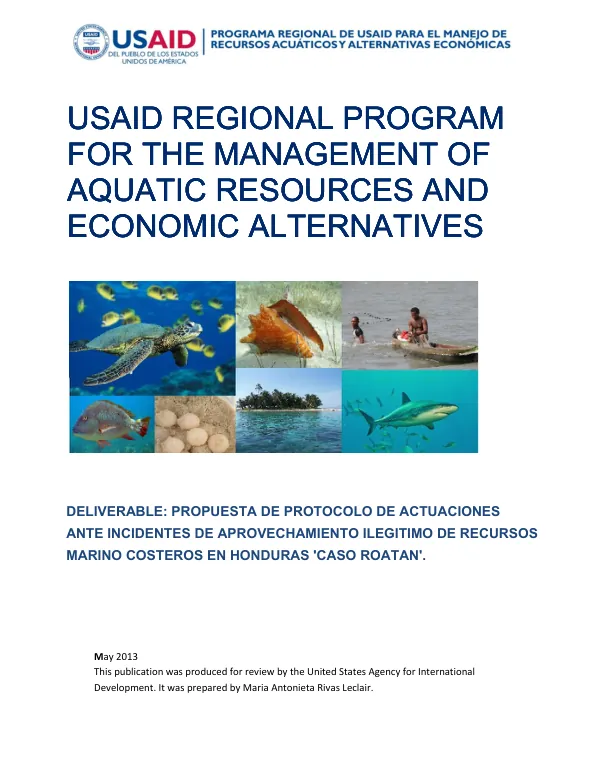
One of the Regional Program's general objectives is to promote effective monitoring and enforcement of coastal-marine law and policies. To this end, the Program designed a strategy to improve environmental law enforcement and strengthen inter-institutional coordination among coastal-marine law enforcement agencies. The strategy focuses on illegal fishing in three pilot sites in the Central American region: Bay Islands in the Gulf of Honduras, on the Caribbean Coast of Honduras; La Union, Gulf of Fonseca, El Salvador; and Chinandega, Gulf of Fonseca, Nicaragua, the latter two on the Pacific Coast. The Operational Protocols will be designed and implemented in the three pilot sites, with the participation of national and local government authorities and organized civil society. The Protocol includes guides for setting up inter-institutional coordination mechanisms and for conducting environmental inspections to strengthen national and local governments and NGOs working in the area. The design process began in February 2013 and the completed Protocol was signed and entered into effect in May of that year. As a final step, fisheries and environmental authorities and the Public Ministry will collaborate on the design, installation, and implementation of a Complaints Tracking System. The Bay Islands National Marine Park in Bay Islands Department was declared a protected area through Decree No. 75-20101. This Park protects a significant portion of the coral reef ecosystem, which forms part of the Meso American Coral System. Located in one of the Regional Program's five target sites, the reef is severely threatened by the global impact of climate change and land-based sources of pollution. Representatives from 12 fisheries and environmental agencies, municipalities, and NGOs collaborated on the development and approval of an Operational Protocol for Incidents Involving the Illegal Use of Coastal and Marine Resources in Honduras "Case of Roatán." The Protocol aims to strengthen the capacity of the relevant agencies and improve environmental oversight, surveillance, inspection, and enforcement through effective coordination among national and local government agencies and NGOs. The goal is to ensure that law enforcement authorities take legal action to combat coastal and marine crimes, based on operational guidelines covering specific scenarios, and aided by clearly designed law enforcement procedures for the most common crimes set out in national environmental law and applicable to Bay Islands National Marine Park. The
Related documents