USAID DEC
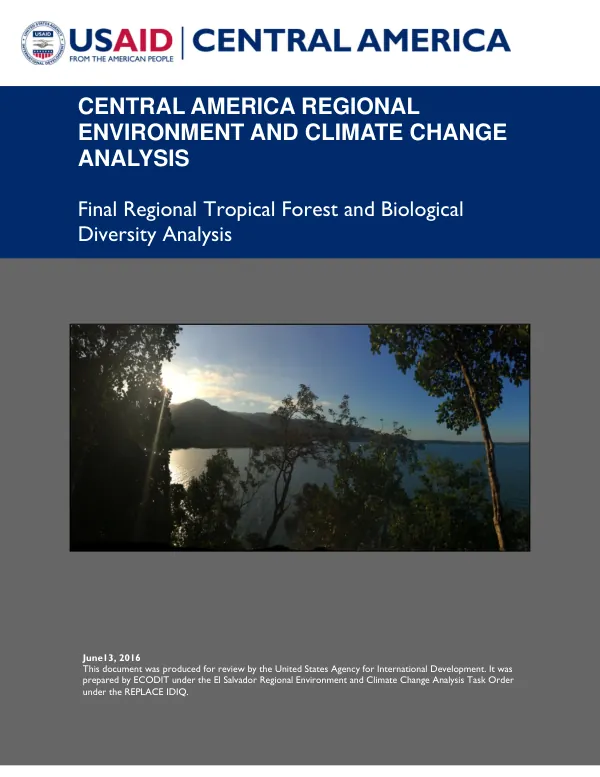
Central America Regional Environment and Climate Change Analysis Final Regional Tropical Forest and Biological Diversity Analysis
Sign inECODIT, INC.
Central America Regional Environment and Climate Change Analysis Final Regional Tropical Forest and Biological Diversity Analysis
The Central America Regional Environment and Climate Change Analysis Final Regional Tropical Forest and Biological Diversity Analysis was produced for review by the United States Agency for International Development.
2016 · 268 pages
Sign in to readA free account is required to download.
Abstract
The report was prepared by ECODIT under the El Salvador Regional Environment and Climate Change Analysis Task Order under the REPLACE IDIQ. The analysis focuses on the tropical forest and biological diversity of Central America, encompassing Belize, Costa Rica, El Salvador, Guatemala, Honduras, Nicaragua, and Panama. The region is characterized by high levels of biodiversity, with many endemic species found nowhere else in the world. However, the region is also facing significant environmental challenges, including deforestation, habitat fragmentation, and climate change. The report highlights the importance of tropical forests in maintaining regional biodiversity, regulating water cycles, and mitigating the effects of climate change. It also emphasizes the need for sustainable forest management practices, including the implementation of Payment for Environmental Services (PES) programs and the promotion of certification schemes such as the Forest Stewardship Council (FSC). The analysis identifies several key drivers of deforestation and habitat loss in the region, including agricultural expansion, urbanization, and infrastructure development. It also highlights the importance of addressing the root causes of deforestation, including poverty and lack of access to alternative livelihoods. The report recommends a range of actions to address the environmental challenges facing Central America, including the development of national and regional policies and strategies for sustainable forest management, the promotion of PES programs and certification schemes, and the support for community-led conservation initiatives. The analysis also highlights the importance of addressing the social and economic dimensions of environmental degradation, including the need to support the livelihoods of rural communities and to promote sustainable agriculture practices. It emphasizes the need for a holistic approach to environmental management, one that takes into account the social, economic, and environmental dimensions of development. The report concludes by emphasizing the need for continued support for environmental conservation and sustainable development in Central America, including the provision of technical assistance, capacity building, and financial resources. It also highlights the importance of strengthening regional cooperation and coordination on environmental issues, including the development of a regional environmental strategy and the establishment of a regional environmental fund.