USAID
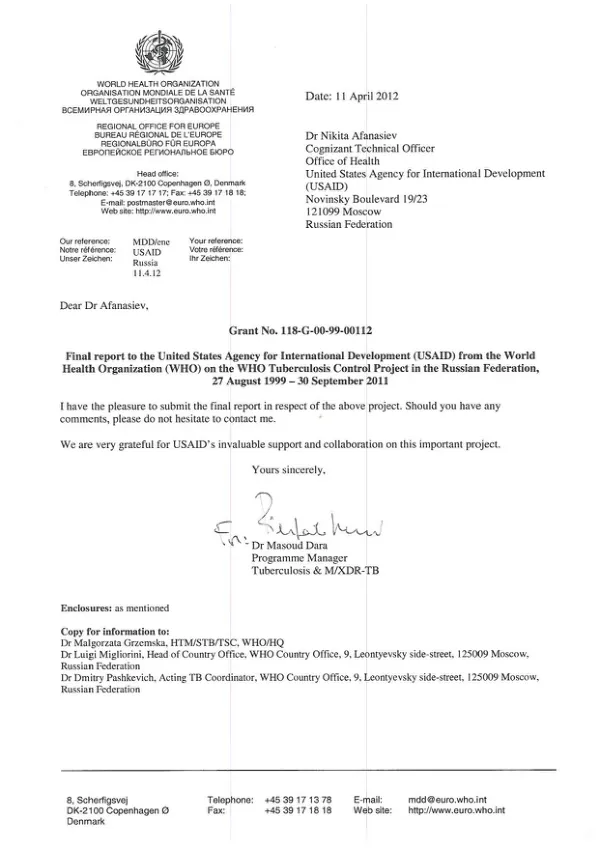
Final Report: WHO Tuberculosis Control Project in the Russian Federation
The WHO Tuberculosis Control Project in the Russian Federation was a pilot program initiated in August 1999, with funding from the United States Agency for International Development (USAID).
2012 · 38 pages
Sign in to readA free account is required to download.
Abstract
The project aimed to reduce morbidity and mortality from tuberculosis (TB), prevent disease transmission, and stop the development of drug-resistant forms of TB among the population. The project was implemented in four regions: Ivanovo, Orel, Vladimir, and Chuvashia, as well as at the Central TB Research Institute of the Russian Academy of Medical Sciences and the Research Institute of Phtisiopulmonology of the First Moscow Medical University. The project had several specific objectives, including capacity building and institutional support for a sustainable TB control model at the regional and national levels, assistance in the development of a sustainable regional model of TB and MDR-TB projects, and assistance to the Russian Government in DOTS expansion through the World Bank loan project on TB and AIDS control. The project also aimed to assist the Russian Health Care Foundation in strengthening TB and MDR-TB control in the country through the Global Fund project. During the project's implementation, the WHO Country Office in the Russian Federation operated on the basis of biennial collaborative agreements between the Ministry of Health and Social Development of the Russian Federation and the WHO Regional Office for Europe. The project made significant progress in implementing the USAID-supported WHO TB Control Programme, with a focus on establishing and developing regional WHO/USAID-supported TB control pilot projects. The project's main activities included capacity building and institutional support for a sustainable TB control model, implementation of the WHO TB Control Strategy at demonstration sites, development of a sustainable regional model of TB and MDR-TB control, training and workshops, coordination of national and international partner activities, and assistance to the Russian Government and the Russian Health Care Foundation in DOTS expansion. The project achieved several major milestones, including the establishment of a sustainable TB control model at the regional and national levels, the development of a sustainable regional model of TB and MDR-TB control, and the expansion of DOTS through the World Bank loan project. The project also made significant progress in reducing morbidity and mortality from TB, preventing disease transmission, and stopping the development of drug-resistant forms of TB. However, the project faced several challenges, including difficulties in implementing the DOTS strategy at the federal and national levels, limited resources and funding, and the need for further capacity building and institutional support. Despite these challenges, the project made significant progress in strengthening TB control in the Russian Federation and contributed to the development of a sustainable regional model of TB and MDR-TB control. The project's future plans and next steps included continued implementation of the WHO TB Control Strategy, further capacity building and institutional support, and expansion of DOTS through the World Bank loan project. The project also aimed to continue assisting the Russian Government and the Russian Health Care Foundation in strengthening TB and MDR-TB control in the country through the Global Fund project. The project's overall goal was to reduce morbidity and mortality from TB, prevent disease transmission, and stop the development of drug-resistant forms of TB among the population. The project's specific objectives included capacity building and institutional support for a sustainable TB control model, assistance in the development of a sustainable regional model of TB and MDR-TB projects, and assistance to the Russian Government in DOTS expansion. The project made significant progress in achieving these objectives and contributed to the development of a sustainable regional model of TB and MDR-TB control in the Russian Federation.
Related documents