USAID DEC
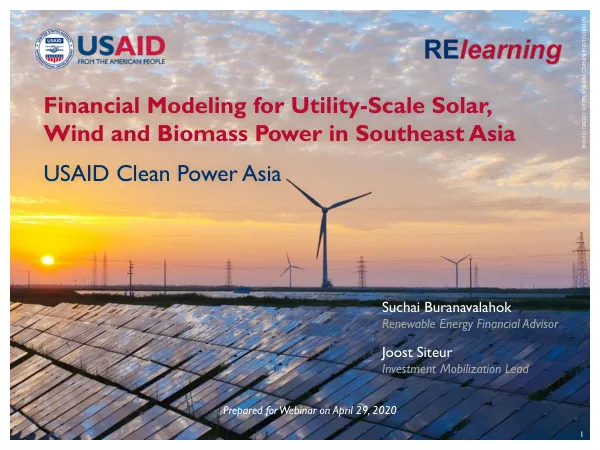
Financial Modeling for Utility-Scale Solar, Wind and Biomass Power in Southeast Asia
Sign inABT ASSOCIATES
Financial Modeling for Utility-Scale Solar, Wind and Biomass Power in Southeast Asia
The USAID Clean Power Asia program aims to increase deployment of grid-connected renewable energy in Southeast Asia.
2020 · 22 pages
Sign in to readA free account is required to download.
Abstract
The program focuses on Cambodia, Lao PDR, Thailand, and Vietnam, with a goal of achieving 500 MW of installed renewable energy capacity by 2021. This target is part of a broader effort to reduce greenhouse gas emissions, with a projected 3.5 million metric tons of CO2 equivalent reduction. The program's investment mobilization goal is $750 million USD, with the objective of supporting the development and financing of renewable energy projects. To achieve this, the program provides tools and guidelines for investment decision-making and project development. These resources include investment guidelines, templates for Power Purchase Agreements, standard financial models, and other tools to support developers, investors, and lenders. The program's financial advisory services offer tailored advice on business models, financial analysis, energy procurement, financing structures, partnerships, contracts, and potential sources of financing. This support is designed to help developers and lenders navigate the complexities of project finance and make informed investment decisions. The program's capacity building initiatives provide training on project finance, cash flow analysis, and the evaluation of renewable energy projects. A key aspect of the program's approach is the use of project finance structures, which involve non-or limited recourse lending against conservative cash flow projections. This structure requires a deep analysis of construction, operating, and revenue risks, as well as restrictions on cash flow to project owners and contracts with warranties and penalties. The program's financial models are designed to simulate the cash flows and debt service associated with renewable energy projects, taking into account factors such as country-specific assumptions, timing, and project finance structures. The program's financial models are crucial tools in project assessment, allowing developers and lenders to evaluate the viability of renewable energy projects and make informed investment decisions. The models incorporate multiple timing flags to track key events and analyze the effects of changes in regulations or market circumstances. By providing a comprehensive framework for project finance and investment decision-making, the USAID Clean Power Asia program aims to support the growth of renewable energy in Southeast Asia and reduce greenhouse gas emissions.