ABT ASSOCIATES
USAID Clean Power Asia: Fostering Supportive Policy Frameworks for Renewable Energy
The USAID Clean Power Asia initiative supports efforts by Lower Mekong countries to foster an environment conducive to the greater development and deployment of grid-connected renewable energy systems.
2018 · 2 pages
Sign in to readA free account is required to download.
Abstract
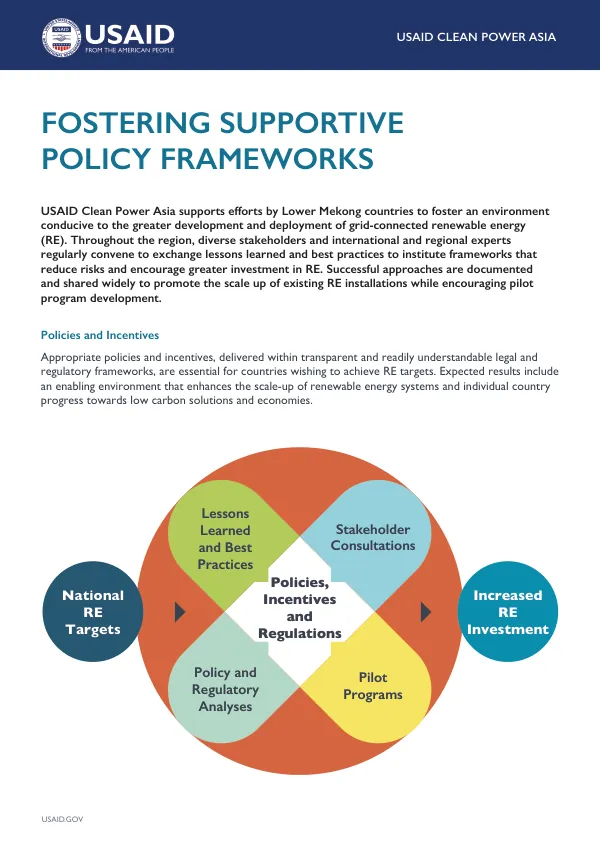
This includes enhancing the scale-up of renewable energy systems and promoting individual country progress towards low carbon solutions and economies. The initiative convenes diverse stakeholders and international and regional experts to exchange lessons learned and best practices, with the goal of reducing risks and encouraging greater investment in renewable energy. Policies, incentives, and regulations play a crucial role in promoting the development and deployment of renewable energy systems. USAID Clean Power Asia assists in streamlining policies and regulations to overcome technical barriers to scaling up renewable energy development. Grid connection regulations, or grid codes, are essential for grid stability and reliability, and improvements in grid codes can reduce or eliminate technical barriers to the development of renewable energy. The initiative focuses on several key areas, including solar power development policies, country auction regulations, and grid connection regulations. Regional studies are conducted in countries such as Thailand, Lao PDR, Cambodia, and Vietnam to analyze the economic impact of solar power on utilities and ratepayers. The initiative also shares lessons learned and best practices across the region, including the development of hybrid policies and the review of grid connection regulations in ASEAN and international best practice. One of the key objectives of the initiative is to improve supporting regulations for grid connection with solar photovoltaics and variable renewable energy. This includes the development of grid codes and connection regulations for solar PV integration, as well as the review of existing regulations to ensure they are supportive of renewable energy development. The initiative also conducts solar pilot auctions, which involve the design, implementation, and evaluation of auctions to promote the development of solar power. The expected outcomes of the USAID Clean Power Asia initiative include the creation of an enabling environment that enhances the scale-up of renewable energy systems and promotes individual country progress towards low carbon solutions and economies. The initiative aims to reduce risks and encourage greater investment in renewable energy, and to promote the development of supportive policies, incentives, and regulations that facilitate the growth of renewable energy markets.