HEALTH POLICY PLUS
Financing Quality Healthcare Across Indonesia's Decentralized Health Sector
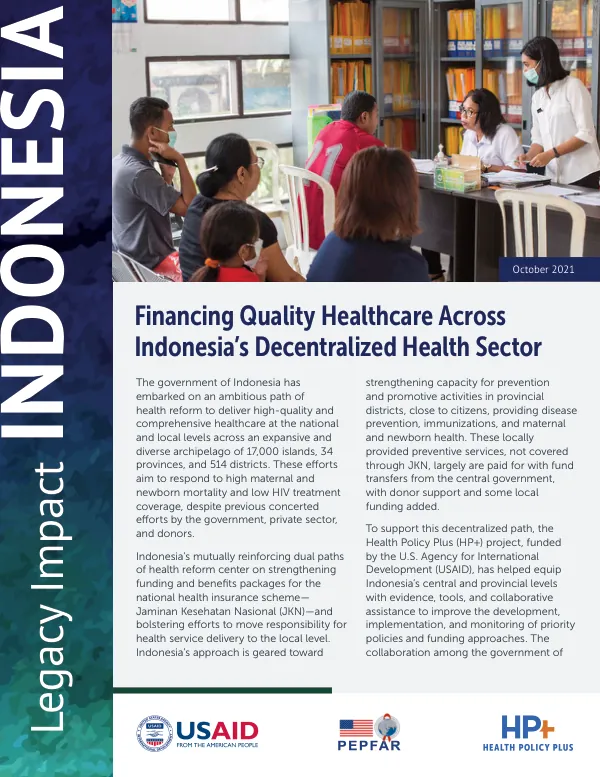
The government of Indonesia has embarked on an ambitious path of health reform to deliver high-quality and comprehensive healthcare across its expansive and diverse archipelago of 17,000 islands, 34 provinces, and 514 districts.
2021 · 8 pages
Sign in to readA free account is required to download.
Abstract
This effort aims to respond to high maternal and newborn mortality and low HIV treatment coverage, despite previous concerted efforts by the government, private sector, and donors. Indonesia's mutually reinforcing dual paths of health reform center on strengthening funding and benefits packages for the national health insurance scheme—Jaminan Kesehatan Nasional (JKN)—and bolstering efforts to move responsibility for health service delivery to the local level. The approach is geared toward strengthening capacity for prevention and promotive activities in provincial districts, close to citizens, providing disease prevention, immunizations, and maternal and newborn health. To support this decentralized path, the Health Policy Plus (HP+) project, funded by the U.S. Agency for International Development (USAID), has helped equip Indonesia's central and provincial levels with evidence, tools, and collaborative assistance to improve the development, implementation, and monitoring of priority policies and funding approaches. The collaboration among the government, key stakeholders in the public and private sectors, and HP+ has strengthened the capacity of local health institutions and entities to act on their own to sustainably finance efforts, gather and use evidence for decision making, and monitor progress in improved health service delivery tailored to local demands and citizen needs. Progress is evident in Indonesia's health reform efforts. The government has enacted laws and regulations creating an enabling environment for decentralized health services. In 2017, the minimum service standards regulation was reformed to ensure equity in service delivery and hold local governments accountable for meeting health targets. Subnational-level autonomy in spending and funding has improved, spurred by increased incentive-driven fund transfers. There is growing interest in strategic purchasing to sustain and improve the HIV response, and nascent engagement with the private health sector promises to strengthen access to health services throughout the island nation. The minimum service standards structure is proving to be the bedrock of Indonesia's decentralized health reform. Bolstering the subnational level with an improved Siscobikes, plus training, has enabled districts and provinces to better understand the health services their citizens need and set priorities among maternal and child health, elderly care, and the prevention of communicable and noncommunicable diseases. The result has been more robust, efficient, and responsive health services that are consistently monitored and tracked—all of which moves Indonesia toward a more high-functioning decentralized health sector and improved health for people. In a decentralized system with a health sector budget facing constraints and a growing JKN deficit, the sustainability of HIV prevention and treatment is a concern. The Directorate of Health Financing and Insurance (PPJK) and the MOH HIV Sub-directorate wanted policy recommendations to achieve better efficiency in JKN coverage for treating HIV. With HP+, these groups considered payment mechanisms to improve HIV care and service delivery; analyzed antiretroviral procurement practices to identify potential regulatory adjustments; improved purchasing practices; and promoted policy dialogue. However, it was clear that JKN repayments for treatment could not fill the gap alone, and prevention of HIV transmission could lessen the need for treatment. Indonesia's CSOs were a key part of the solution, and HP+ analysis showed that combined efforts from government and from CSOs that provided preventive and promotive services could help achieve better efficiency in JKN coverage for treating HIV. The collaboration among the government, key stakeholders in the public and private sectors, and HP+ has led to several key outcomes. The government has revised the current SPM budgeting tool (Siscobikes) and strengthened the capacity of districts to use the tool, which also helps improve the management of healthcare delivery at the local level. The Ministry of Home Affairs, the MOH, the Ministry of Finance, and HP+ have collaboratively developed eight e-learning modules for the revamped Siscobikes to strengthen subnational staff skills in using the improved data for decision making. Those materials are now used by thousands of civil servants to gain knowledge on budgeting and planning for SPM. The same group of agencies has also provided inputs to address the lack of interoperability between government ministry data platforms used to monitor SPM, and HP+ has created interoperable dashboards and databases embedded in Siscobikes to aid local government reporting to the MOH.
Related documents
Documents in this collection
 2021
2021USAID DEC
Strengthening Indonesia’s capacity to use mechanical ventilators for COVID-19 treatment and mitigation: Field monitoring report
Open record 2021
2021USAID DEC
Final Report: Stronger Together by Learning Together: Learnings from Supporting Academic Partnerships - STAR Collaboration Laboratory
Open record