USAID DEC
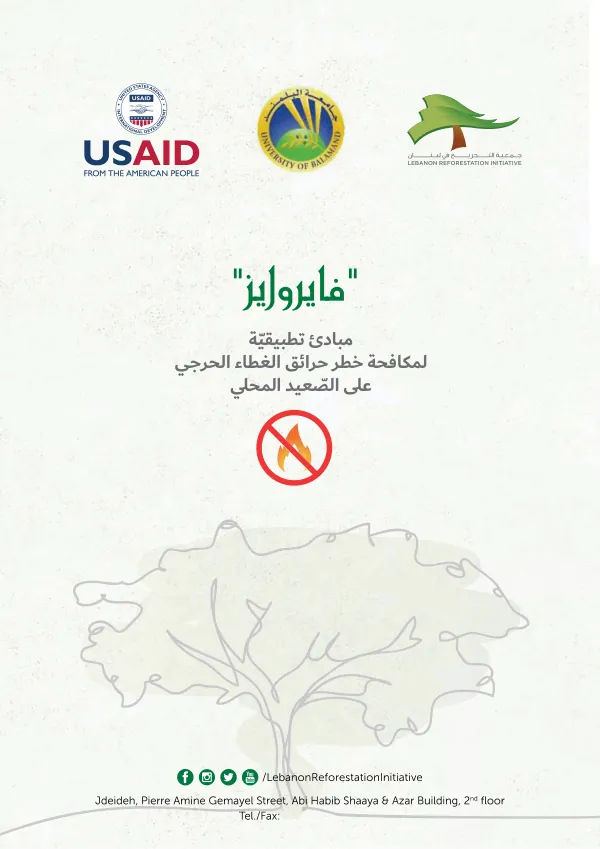
Firewise Best practice guidelines for wildfire risk management at the local level_EH cmnts-arabic-low res
Sign inFAO
Firewise Best practice guidelines for wildfire risk management at the local level_EH cmnts-arabic-low res
The agricultural development initiative in Lebanon began in 2018 with funding from the United States Agency for International Development (USAID) and the Lebanese Ministry of Agriculture.
24 pages
Sign in to readA free account is required to download.
Abstract
The initiative was implemented by the Lebanese Ministry of Agriculture, in partnership with the International Organization for Migration (IOM) and the University of Balamand (UOB). The project aimed to improve agricultural productivity and market access for smallholder farmers in Lebanon. The project's methodology involved conducting a baseline survey to assess the current situation of smallholder farmers in Lebanon. The survey collected data on farmers' characteristics, agricultural practices, and market access. The data was then used to identify the most critical challenges facing smallholder farmers and to design interventions to address these challenges. The project's interventions included farmer training programs, infrastructure development, and market linkage facilitation. The farmer training programs aimed to improve farmers' knowledge and skills in sustainable agriculture practices, such as composting and crop rotation. The infrastructure development component aimed to improve access to irrigation systems and other agricultural inputs. The market linkage facilitation component aimed to connect smallholder farmers with markets and buyers. The project's geographic focus was on the Eastern Province of Lebanon, which is one of the most vulnerable regions in the country. The project's timeframes were from 2018 to 2022, with a midterm evaluation conducted in 2020. The project's recommendations included scaling up the farmer training programs and infrastructure development interventions. The project also recommended strengthening the market linkage facilitation component to ensure that smallholder farmers have better access to markets and buyers. The project's findings and conclusions were based on data collected from the baseline survey and midterm evaluation. The data showed that the project's interventions had a positive impact on smallholder farmers' livelihoods, with improvements in crop yields, household income, and food security. The project's implementation details were managed by the Lebanese Ministry of Agriculture, in partnership with the IOM and UOB. The project's budget was funded by USAID and the Lebanese Ministry of Agriculture. The project's timeframes were from 2018 to 2022, with a midterm evaluation conducted in 2020. The project's recommendations included scaling up the farmer training programs and infrastructure development interventions. The project also recommended strengthening the market linkage facilitation component to ensure that smallholder farmers have better access to markets and buyers. The project's geographic focus was on the Eastern Province of Lebanon, which is one of the most vulnerable regions in the country. The project's methodology involved conducting a baseline survey to assess the current situation of smallholder farmers in Lebanon. The survey collected data on farmers' characteristics, agricultural practices, and market access. The data was then used to identify the most critical challenges facing smallholder farmers and to design interventions to address these challenges.
Related documents