USAID
Firm-Level Cooperation and Competition: Horizontal Linkages for Economic Growth
Firm-level cooperation and competition are essential for economic growth and poverty reduction.
2009 · 4 pages
Sign in to readA free account is required to download.
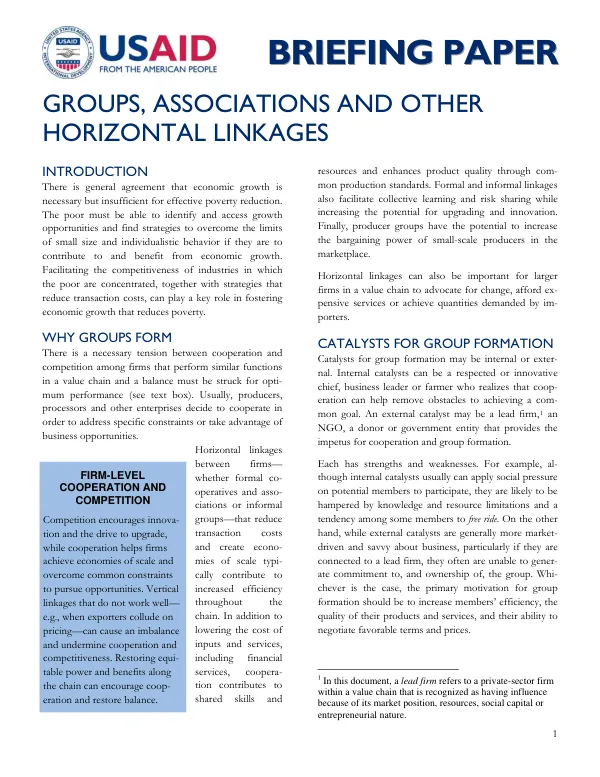
Abstract
Competition encourages innovation and the drive to upgrade, while cooperation helps firms achieve economies of scale and overcome common constraints to pursue opportunities. However, vertical linkages that do not work well can cause an imbalance and undermine cooperation and competitiveness. Restoring equitable power and benefits along the chain can encourage cooperation and restore balance. There is general agreement that economic growth is necessary but insufficient for effective poverty reduction. The poor must be able to identify and access growth opportunities and find strategies to overcome the limits of small size and individualistic behavior if they are to contribute to and benefit from economic growth. Facilitating the competitiveness of industries in which the poor are concentrated, together with strategies that reduce transaction costs, can play a key role in fostering economic growth that reduces poverty. Horizontal linkages between firms, whether formal cooperatives and associations or informal groups, can reduce transaction costs and create economies of scale, contributing to increased efficiency throughout the chain. Cooperation contributes to shared skills and resources, enhances product quality through common production standards, and facilitates collective learning and risk sharing. Producer groups have the potential to increase the bargaining power of small-scale producers in the marketplace. Catalysts for group formation may be internal or external. Internal catalysts can be a respected or innovative chief, business leader, or farmer who realizes that cooperation can help remove obstacles to achieving a common goal. External catalysts may be a lead firm, an NGO, a donor, or government entity that provides the impetus for cooperation and group formation. Each has strengths and weaknesses, and the primary motivation for group formation should be to increase members' efficiency, the quality of their products and services, and their ability to negotiate favorable terms and prices. Groups can be informal or formal depending on their resources, relationships, roles, and rules. The degree of formality needed to create or maintain the links between members depends on characteristics internal and external to the group. Internal factors include cultural context, social capital, the reason for group formation, and members' knowledge and resources and their leadership abilities. Externally, group structure and formality are determined by government policies and regulations governing groups or associations, infrastructure, and the nature and competitiveness of the industry or service. The success of a collaborative venture depends on several conditions, including similar commercial orientation, knowledge, and productive resources of members; internal trust and social capital; external demand for product quality and quantity that individuals alone cannot satisfy; potential for economies of scale in production, processing, marketing, and purchasing; and benefits of cooperation exceeding its cost, including time invested. Critical to ensuring internal cohesion and a member-driven agenda are a common vision and purpose and a match between members' skills and the activities they choose to implement. Factors that can erode cooperative behavior include a lack of trust between members; predatory, opportunistic, or fraudulent behavior by leaders; free rider or side-selling behavior by members; an agenda driven by social capital activities or bonding; or group formation initiated by an outside organization with more than one agenda. An essential element of effective cooperation is trust, which can be built on social capital generated by existing group activities.