USAID DEC
Impact of Male Engagement for Gender Equality: Sustained Impact and Changes in Southwest Bangladesh
Sign inUSAID
Impact of Male Engagement for Gender Equality: Sustained Impact and Changes in Southwest Bangladesh
The Male Engagement for Gender Equality project in southwest Bangladesh was implemented by World Vision Bangladesh, with funding from USAID's Food for Peace program.
2020 · 36 pages
Sign in to readA free account is required to download.
Abstract
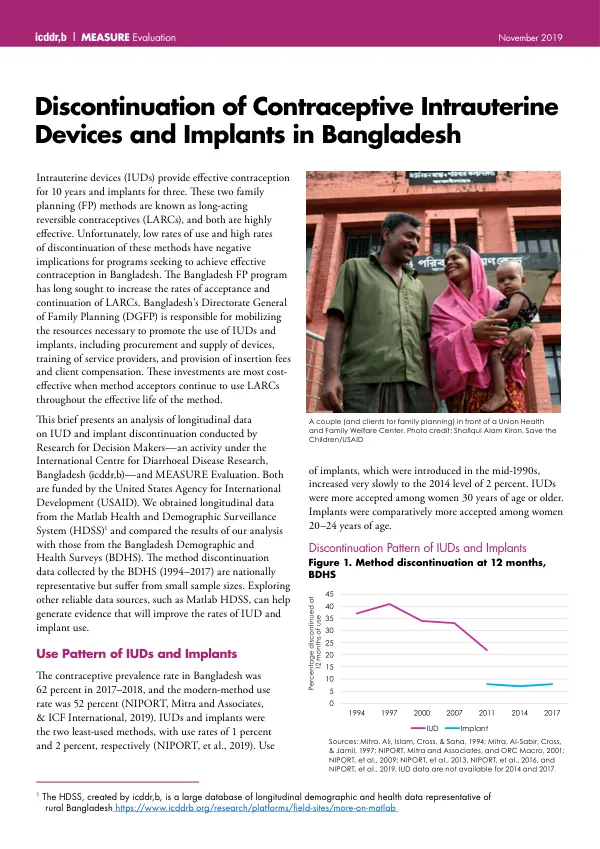
The project aimed to promote gender equality and reduce violence against women through male engagement. The project was conducted in four sub-districts in southwest Bangladesh and involved 5 thematic modules and 12 sessions over nine months. The male engagement sessions covered key concepts such as shared decision-making, fair division of domestic and caregiving tasks, improving and supporting healthy relationships within families, supporting gender equity, nonviolence, and discouraging child marriage, and improving understanding of gender equity and its impact on relationships between men and women. A total of 7,120 couples completed the male engagement activity since 2017. Evidence of positive changes in perceptions, captured through annual monitoring, shows that participation in the male engagement activity has a significant impact on perceptions related to gender-equitable practices at the household level. Specifically, 77% of men think that women should be consulted on household budgeting and purchases, compared to a baseline value of 43.30%. Additionally, 41.6% of men think that women should be able to access markets, health care services, and other public locations without restrictions or prior consultation, compared to a baseline value of 18.30%. Furthermore, 58.3% of men think that men and women should share household tasks, such as cleaning, cooking, and taking care of children, compared to a baseline value of only 8.30%. The study aimed to investigate the extent to which the project has managed to change attitudes, perceptions, and behaviors on gender equality and to further understand how to sustain the impact of the male engagement approach. The study used a mixed-methods approach, combining quantitative and qualitative research components. A participant-based sampling survey was conducted, which involved collecting data from 210 couples under treatment/case groups and 70 couples under control/comparison groups. Qualitative information was collected through focus group discussions, key informant interviews, case stories, and consultations. The study found that the male engagement intervention has a significant impact on improving gender equity in households. The study also developed a strategic plan on how the male engagement approach can be sustained with regard to sustained change in perceptions, knowledge, attitudes, and practices of men and boys. Additionally, the study enhanced the effectiveness and quality of male engagement through learning and adaptation. The project's success can be attributed to its contextualized approach, which took into account the local culture and context. The project's focus on shared decision-making, fair division of domestic and caregiving tasks, and improving and supporting healthy relationships within families has led to positive changes in perceptions and behaviors among men. The project's emphasis on promoting gender equity and reducing violence against women has also contributed to its success. The study's findings have important implications for policymakers and practitioners working to promote gender equality and reduce violence against women. The study's results suggest that male engagement can be an effective strategy for promoting gender equality and reducing violence against women. The study's findings also highlight the importance of contextualizing interventions to take into account local culture and context. The study's recommendations include continuing to support the male engagement approach and scaling it up to reach more men and boys. The study also recommends strengthening the capacity of local stakeholders to sustain the impact of the male engagement approach. Additionally, the study recommends continuing to monitor and evaluate the project's impact to ensure that it is meeting its objectives and to identify areas for improvement. Overall, the Male Engagement for Gender Equality project in southwest Bangladesh has been successful in promoting gender equality and reducing violence against women through male engagement. The project's contextualized approach, focus on shared decision-making, fair division of domestic and caregiving tasks, and improving and supporting healthy relationships within families have led to positive changes in perceptions and behaviors among men. The study's findings have important implications for policymakers and practitioners working to promote gender equality and reduce violence against women.
Related documents