USAID DEC
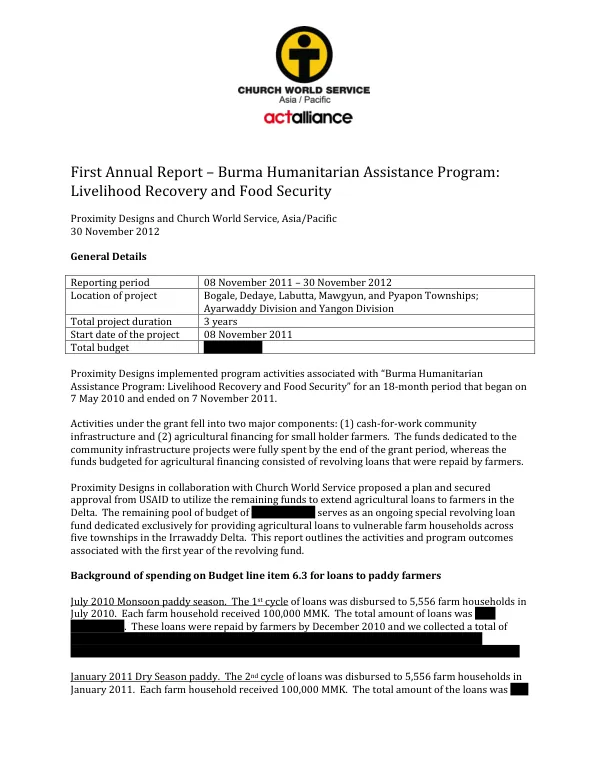
First Annual Report – Burma Humanitarian Assistance Program: Livelihood Recovery and Food Security
Sign inUSAID DEC
First Annual Report – Burma Humanitarian Assistance Program: Livelihood Recovery and Food Security
The Burma Humanitarian Assistance Program: Livelihood Recovery and Food Security was implemented by Proximity Designs and Church World Service, Asia/Pacific, in collaboration with USAID.
2012 · 15 pages
Sign in to readA free account is required to download.
Abstract
The program aimed to provide agricultural financing to small holder farmers in the Irrawaddy Delta, with a focus on improving livelihoods and food security. The program's activities were divided into two major components: cash-for-work community infrastructure and agricultural financing for small holder farmers. The agricultural financing component was a revolving loan fund that provided loans to farmers in the Delta. The program's lending services were designed to coincide with the seasonal farm calendar, with loans disbursed twice a year for monsoon and summer rice farmers. The loan size was fixed at MMK 100,000, or approximately USD 120, and interest was paid with the principal at the end of the loan term. The program was carried out through 318 community-based organizations (CBOs), which were established in the aftermath of Cyclone Nargis. The program's impact was assessed through surveys of 364 respondents and 250 members from 50 village committees. The results showed that farm households with sufficient capital typically increased their productivity and yields by 25 percent, representing an increase in income of USD 50 per acre or USD 250 for a five-acre farm per season. The majority of loan program participants were satisfied with the crop loan process, with 97 percent finding the payment process convenient. Eighty percent of participants also received farm advisory services from Proximity Designs, which many cited as a reason for an increase in yield. The program's design focused on providing simple, practical, and low-cost techniques that rice farmers could adopt easily to boost yields and incomes. These techniques included rice seed selection method using saltwater solution, "green manure" using legumes to help fix the soil with nitrogen and cutting down on chemical fertilizer costs, and integrated pest management techniques that were more environment-friendly and sustainable. To date, over 16,000 farmers had adopted these income-boosting techniques in the Delta. The program's operating environment was affected by the issuance of a new Microfinance Law by Burma's Ministry of Finance. The law allowed private, non-bank institutions to operate and imposed a cap on the lending rate of 30 percent per annum. However, the macro economy in rural areas was severely depressed, and the overvalued exchange rate was damaging both agriculture and the economy as a whole. The program's geographical distribution of agriculture financing was as follows: Bogale had 100 Proximity CBOs administering crop loans, Dedaye had 69, Labutta had 32, Mawgyun had 59, and Pyapon had 58. The program's financial status was detailed in Appendix 3, which showed the total amount of loans disbursed and collected during the reporting period.