CORE INTERNATIONAL, INC.
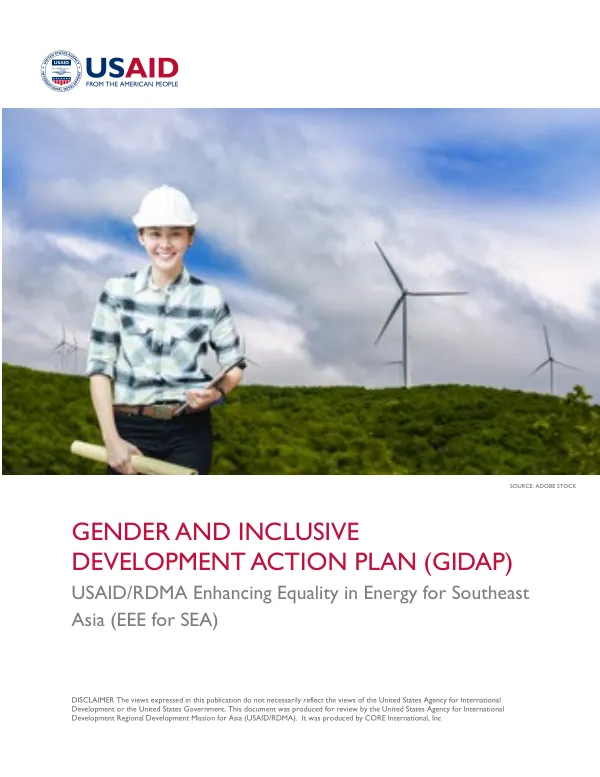
FINAL (REVISED) GIDAP_EEEforSEA
The Enhancing Equality in Energy for Southeast Asia (EEE for SEA) Activity aims to improve gender equality and inclusion in the energy sector by providing support to the sector across the focus countries.
2021 · 34 pages
Sign in to readA free account is required to download.
Abstract
This Activity is a part of Asia Enhancing Development and Growth through Energy (Asia EDGE), a U.S. government-wide initiative launched in 2018 as a component of the Administration's Indo-Pacific Strategy. The EEE for SEA Activity will be implemented across 5 countries in the SEA region: Cambodia, Indonesia, the Philippines, Thailand, and Vietnam, with potential in 2 additional countries (Burma and Lao PDR). The goal of the Activity is to improve gender equality in the energy sector and achieve a sustainable and secure industry that contributes to women's empowerment. The EEE for SEA Activity focuses on three objectives: increasing the diversity of the energy sector workforce, supporting inclusive workplace environments, and increasing promotion and leadership opportunities for women. To achieve these objectives, the Activity will implement the following interventions: farmer training, infrastructure development, and market linkage facilitation. The Activity will also establish a mentoring program and conduct a preliminary stakeholder analysis to identify key partners and stakeholders. The GIDAP outlines the specific actions to be taken by the CORE Team, together with the USAID RDMA, to achieve its joint objective of contributing towards gender equality and social inclusion within the energy sector. The GIDAP is guided by the findings of the EEE for SEA Activity Gender Equality and Social Inclusion (GESI) Analysis and the recommendations emerging from a review of publicly available literature on gender equality and social inclusion within the SEA energy sector. The EEE for SEA Activity's Gender Specialist, with support from the CORE Team and advisory support from the USAID RDMA Senior Gender Specialist, will lead all GIDAP activities. The GIDAP is a living document, and its activities may be adjusted and complemented or removed during Activity implementation to ensure maximum impact. The GIDAP will be reported to USAID via the CORE Team's reporting mechanisms. The GIDAP aligns with the EEE for SEA Activity's Performance Work Statement (PWS), which has five objectives: identifying core challenges to gender equality in the energy sector in Southeast Asia, increasing the number of women and girls pursuing careers in the energy sector, increasing the recruitment, promotion, and promotion of women in the energy sector, and enhancing communication, collaboration, and collaboration. The COVID-19 pandemic has significantly impacted the energy sector, particularly for women entrepreneurs who have played a serious role in providing clean energy to local communities and creating income-generating activities for themselves, other excluded persons, and their families. The pandemic has also hampered employment and the workplace, particularly for women in the energy sector. The EEE for SEA Activity will consider these impacts in its implementation and support to its energy sector partners. The EEE for SEA Activity will track its GESI capacity and opportunities to strengthen knowledge and skills within its own team to respond to the needs of its partners and promote gender equality and social inclusion within the partner organizations. The Activity will also report its progress and updates to USAID via the CORE Team's reporting mechanisms. The EEE for SEA Activity's GESI integration approach will be implemented to fill data gaps as part of Objective 1 and address challenges and leverage opportunities to contribute towards gender equality and inclusion across Objectives 2-5. The Activity will also provide a guide to the CORE Team's capacity development plan, including a training and potential participation schedule, to ensure GESI skills and sharing across all Activity personnel. The EEE for SEA Activity's implementation plan responds to the need to adapt to the COVID-19 pandemic. The Activity team remains flexible to ensure that as more data is discovered regarding the impact of COVID-19 on its partners and community members, support will be tailored accordingly. The Activity will also consider the COVID-19 pandemic's impacts on employment and the workplace, particularly for women in the energy sector.