INTERNATIONAL PEACE CORPS
First community mobile library to launch in Gicumbi
The Literacy, Language, and Learning (L3) Initiative Community Mobile Library was launched in Cyuru, Gicumbi district, Rwanda on December 10, 2012.
2012 · 2 pages
Sign in to readA free account is required to download.
Abstract
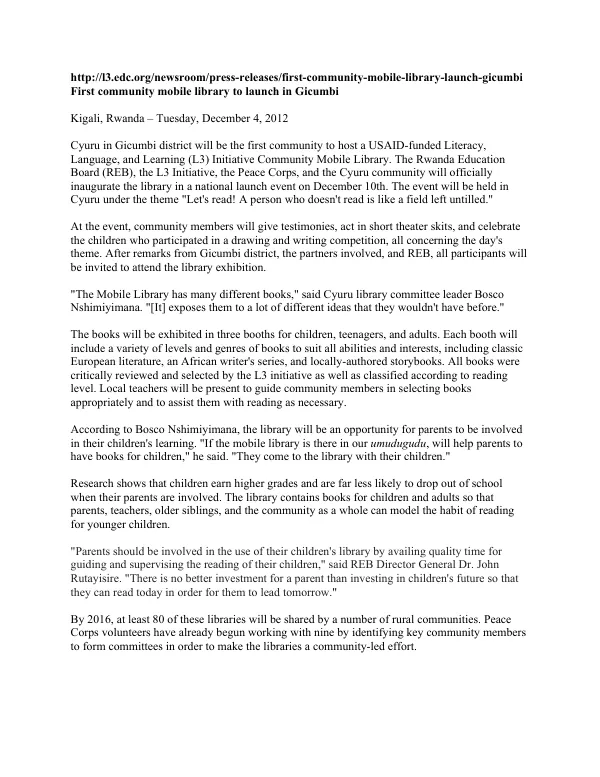
The library was inaugurated as part of a national launch event, with the theme "Let's read! A person who doesn't read is like a field left untilled." The event featured community members sharing testimonies, participating in short theater skits, and celebrating children who participated in a drawing and writing competition. The library, funded by USAID, is designed to provide access to a wide range of books for children, teenagers, and adults. The collection includes classic European literature, an African writer's series, and locally-authored storybooks, all of which have been critically reviewed and selected by the L3 initiative. The books are classified according to reading level, and local teachers will be present to guide community members in selecting books and assisting with reading as necessary. The library is expected to play a significant role in promoting literacy and education in the community. Research has shown that children who have involved parents tend to earn higher grades and are less likely to drop out of school. The library contains books for children and adults, allowing parents, teachers, and older siblings to model the habit of reading for younger children. This, in turn, is expected to have a positive impact on the community's educational outcomes. The library is a community-led effort, with a committee formed to oversee its operations. Peace Corps volunteers have already begun working with nine communities to establish similar libraries, with the goal of having at least 80 libraries shared by rural communities by 2016. The libraries are designed to be mobile, allowing them to be easily transported to different locations within the community. The launch of the library in Cyuru marks an important step towards improving literacy and education in Rwanda. The library's collection of books and the community's involvement in its operations are expected to have a lasting impact on the community's educational outcomes. The library's success is also expected to serve as a model for other communities in Rwanda, highlighting the importance of community-led initiatives in promoting literacy and education.