USAID DEC
First Principles: Designing Effective Education Programs (In-Service Teacher Professional Development Digest)
Sign inUSAID
First Principles: Designing Effective Education Programs (In-Service Teacher Professional Development Digest)
In-service teacher professional development is a critical component of education reform, aimed at improving the knowledge, skills, and commitments of teachers to enhance student learning outcomes.
2018 · 8 pages
Sign in to readA free account is required to download.
Abstract
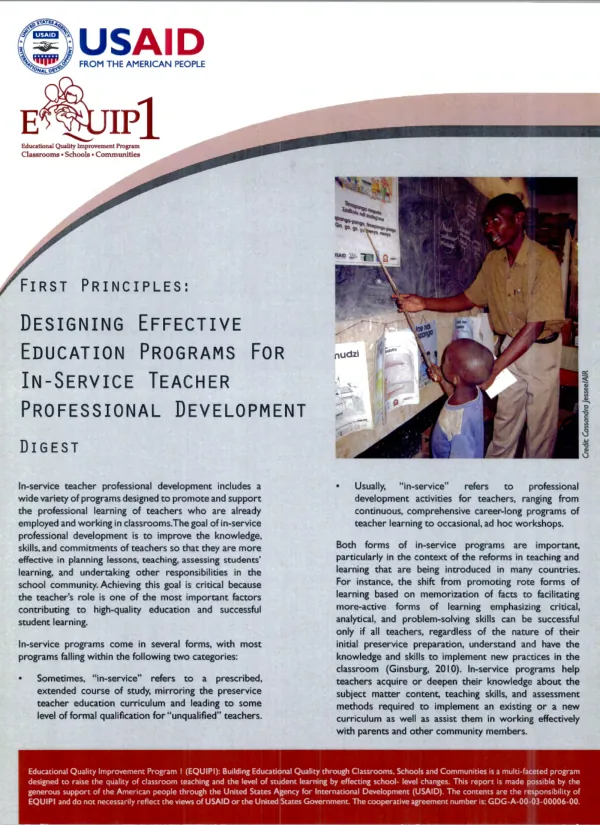
The goal of in-service professional development is to equip teachers with the necessary tools and expertise to plan effective lessons, teach, assess student learning, and engage with the school community. In-service programs come in various forms, including prescribed courses of study and professional development activities for teachers. Both forms are essential, particularly in the context of education reforms that emphasize critical, analytical, and problem-solving skills. In-service programs help teachers acquire or deepen their knowledge about subject matter content, teaching skills, and assessment methods required to implement new curricula. The Educational Quality Improvement Program I (EQUIP I) is a multi-faceted program designed to raise the quality of classroom teaching and student learning by effecting school-level changes. The program is guided by key principles that facilitate successful programming, including considering in-service programs as part of a continuum of professional development. This continuum starts with preservice education, includes periods of school-based inquiry and practice teaching, and continues into an induction/mentoring period of introduction into full-time teaching. A continuous program of career-long professional development, support, and supervision follows, ideally building on previously acquired knowledge and skills. Involving teachers in planning programs is also crucial, as it ensures that their needs and students' needs are addressed. Teachers should be involved in the planning of both the structure and content of in-service programs to promote their ownership and support for the programs. Staff of institutions offering preservice programs should also be involved in planning and implementing in-service programs to enhance continuity across phases of professional development. Emphasizing pedagogical content knowledge in designing program content is essential, as it involves a focus on subject matter content with its implications for pedagogy. Pedagogical content knowledge helps teachers understand curricular content better and be more effective in making a subject comprehensible to students. Professional development programs will benefit teachers most if they are based on strengthening teachers' knowledge of subject matter drawn from the curriculum that they are currently using in the classroom. In Ethiopia, adult-oriented student learning models are used, which combine theoretical and practical knowledge acquisition, skill demonstration, and hands-on learning-by-doing. These models are most effective in facilitating professional learning for teachers, as they emphasize practical learning and reinforce participatory and discovery approaches that teachers currently use in their classrooms. The First Principles: Designing Effective Education Program provides an overview and guidance for designing and implementing in-service programs. The principles, steps, and indicators are primarily meant to guide program designs, including the development of requests for and subsequent review of proposals, the implementation of program activities, and the development of performance management plans, evaluations, and research studies.
Related documents