USAID DEC
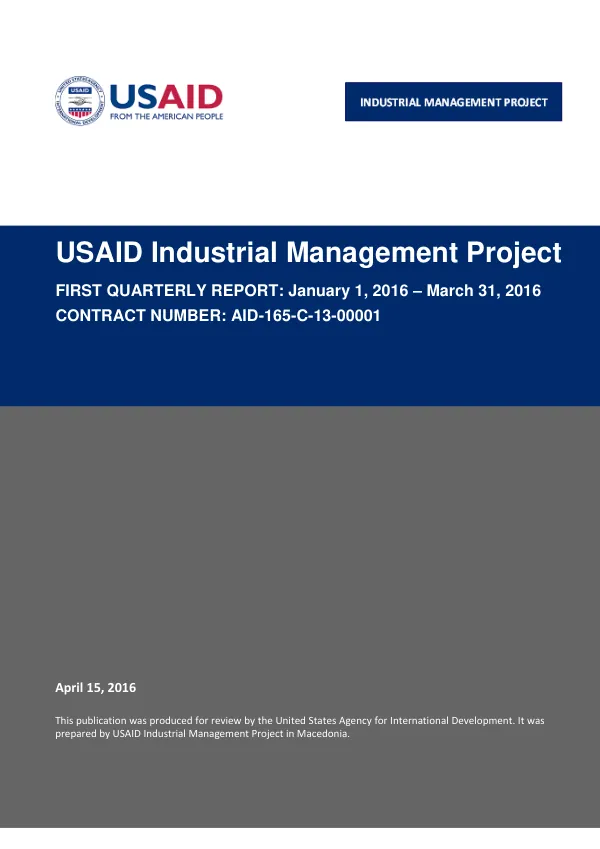
First Quarterly Narrative Report: January 1, 2016 – March 31, 2016
The Industrial Management Project (IMP) is a three-year initiative aimed at improving the competitiveness and energy security of Macedonian industries.
2016 · 17 pages
Sign in to readA free account is required to download.
Abstract
The project is managed by Timel, a Prime Contractor to the USAID, in collaboration with the Center for Entrepreneurship and Executive Development – CEED Macedonia and PrimePro Consulting. The project's overall objective is to introduce the principles of energy management to selected Macedonian industries based on the ISO 50001:2011 standard. The IMP focuses on reducing greenhouse gas emissions and promoting clean energy investments. The project's implementation is guided by the USAID/Macedonia Strategic Plan 2011-2015, which emphasizes the importance of strengthening key private sector capacities, including the development of globally competitive products and services. The project's activities are designed to support the USAID/Macedonia primary objective of increasing job-growth in the private sector. During the first quarter of 2016, the IMP continued to develop energy efficiency upgrade projects, including an energy efficiency project at Kadino Group. The project also discussed opportunities for improvement with several other companies, including Messer Vardar Tehnogas, Makprogres, and DIK Fagus. On March 4, 2016, the IMP completed and delivered the energy efficiency upgrade project for Veze Sharri. The IMP's Chief of Party was featured in a press conference to present the results accomplished in the three-year implementation period. The project's activities and events were also promoted through the USAID Macedonia website. The IMP's focus on energy management and sustainability is critical for the competitiveness and survival of Macedonian industries, particularly in the face of high energy costs and regional competition. The project's approach is systematic and founded on the ISO 50001:2011 standard. The IMP's activities are designed to help companies better understand their energy consumption patterns and adopt organizational practices to manage energy use more efficiently. The project's implementation is managed by Timel, a Prime Contractor to the USAID, in collaboration with the Center for Entrepreneurship and Executive Development – CEED Macedonia and PrimePro Consulting. The IMP's quarterly report highlights the project's progress and accomplishments during the first quarter of 2016. The report provides an overview of the project's activities, including the development of energy efficiency upgrade projects and the promotion of the project's results through a press conference. The report also highlights the project's focus on energy management and sustainability, which is critical for the competitiveness and survival of Macedonian industries. The project's implementation is guided by the USAID/Macedonia Strategic Plan 2011-2015, which emphasizes the importance of strengthening key private sector capacities, including the development of globally competitive products and services. The project's activities are designed to support the USAID/Macedonia primary objective of increasing job-growth in the private sector. The IMP's quarterly report provides an overview of the project's progress and accomplishments during the first quarter of 2016. The report highlights the project's focus on energy management and sustainability, which is critical for the competitiveness and survival of Macedonian industries. The project's implementation is managed by Timel, a Prime Contractor to the USAID, in collaboration with the Center for Entrepreneurship and Executive Development – CEED Macedonia and PrimePro Consulting. The project's activities are designed to help companies better understand their energy consumption patterns and adopt organizational practices to manage energy use more efficiently. The project's implementation is guided by the USAID/Macedonia Strategic Plan 2011-2015, which emphasizes the importance of strengthening key private sector capacities, including the development of globally competitive products and services.
Related documents