USAID DEC
First year evaluation population and family planning project no. 518-0026 : cooperative agreement no. LAC-0518-A-00-1055-00, dated 9/30/81 and amendments no. 1 and 2, AID and IPPF/Western Hemisphere Region, November 29-December 3, 1982
Sign inUSAID. MISSION TO ECUADOR
First year evaluation population and family planning project no. 518-0026 : cooperative agreement no. LAC-0518-A-00-1055-00, dated 9/30/81 and amendments no. 1 and 2, AID and IPPF/Western Hemisphere Region, November 29-December 3, 1982
Evaluates project to promote family planning (FP) and increase awareness of population problems in Ecuador.
Amadeo, Jesus|Denman, David · 1982
Sign in to readA free account is required to download.
Abstract
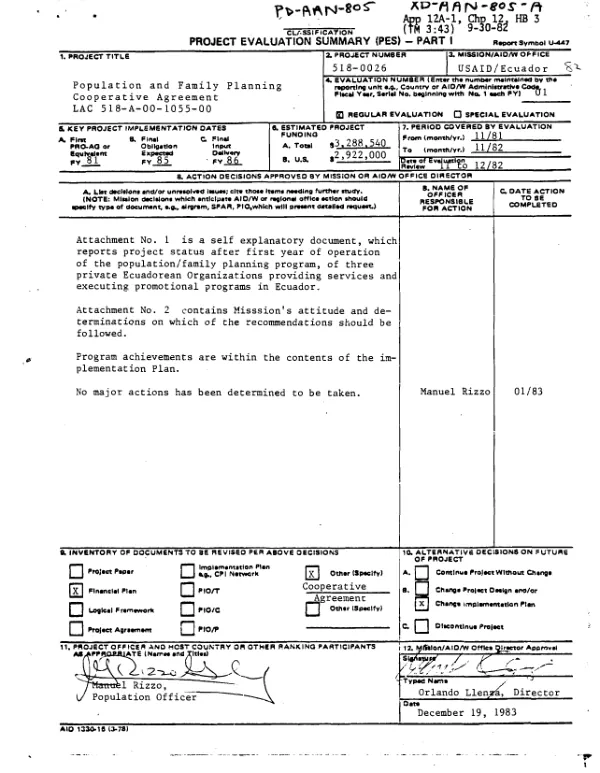
Special evaluation, focusing on private sector subgrantees, covers the period 11/81-11/82 and is based on site visits, interviews, and document review. It appears that project targets will be met. CEMOPLAF (the Medical Center for FP and Orientation) opened a clinic (3 are planned) in Guayaquil in 1/82. While the clinic is below target for new acceptors, corrective steps have been taken and CEMOPLAF is expected to reach 1,180 new acceptors during 1982 (67% of target). CEMOPLAF is above target in terms of women motivated in individual interviews, and has also developed educational materials and advertised clinic services on radio. A second clinic, in Esmeraldos, should open in 1/83. CEPAR (the Center for the Promotion of Responsible Parenthood) has surpassed its goals in virtually all areas. A Documentation Center on Population and FP has been opened. The center's collection exceeds targets, but public response has been disappointing. CEPAR also surpassed targets in identifying leaders and mass media. Training activities have been close to schedule; a training center was opened in 4/82, 30 potential FP instructors have been trained, a seminar was held for 25 social workers, and a course for physicians is planned. Research and publications have been less successful - the one research study completed is not entirely satisfactory. Planned activities of the third subgrantee, APROFE (the Association for the Welfare of the Ecuadorean Family), have been postponed due to a perceived funding overlap. The International Planned Parenthood Federation/Western Hemisphere (IPPF/WH) coordinating office was established in Quito early in l982. IPPF performance has been high, but continued TA to subgrantees is needed. Major issues and problems have been: an excess of funds due to devaluation of the sucre, causing a need to consider additional activities; subgrantee expenditures in excess of disbursements; difficulties in receiving approval for duty free import of equipment; need for additional supportive training and information efforts; and need to assure private agency leadership of future funding. Detailed recommendations are made for IPPF/WH and each subgrantee.
Related documents