MICROSOFT CORPORATION
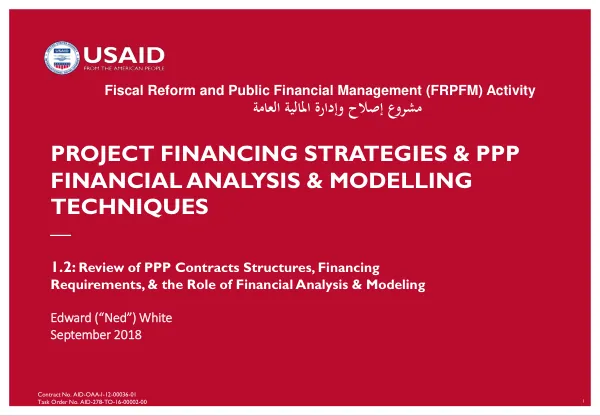
Fiscal Reform and Public Financial Management (FRPFM) Activity
Public-Private Partnerships (PPPs) are a form of legally enforceable contract between the public sector and private sector, which requires new investments by the private contractor and transfers key risks to the private sector.
2018 · 86 pages
Sign in to readA free account is required to download.
Abstract
Payments are made in exchange for performance, for the purpose of delivering a service traditionally provided by the public sector. PPPs are defined by "HOW" a public service is delivered, not by "WHAT" the underlying infrastructure or asset is. Jordan's PPP Institutional Framework consists of several phases, including registration and application, PPP project preparation, PPP tendering and procurement, and PPP contract management and performance monitoring. The framework involves various stakeholders, including the PPP Unit, PPP Council, and Council of Ministers. The PPP Unit is responsible for reviewing PPP applications and recommending candidates for PPP projects. Private investments in infrastructure in developing economies have increased significantly over the years. According to the International Private Investment in Infrastructure Record, private investments in infrastructure in developing economies reached $100 billion in 2015. In Jordan, private investments in infrastructure have also increased, with a total of 21 projects and transactions between 1990 and 2017. The investment size for these projects ranged from $50 million to $2.1 billion. The PPP projects in Jordan include various sectors such as energy, information and communication technology (ICT), transport, and water and sewerage. The projects involve different types of contracts, including build, operate, and transfer (BOT), build, own, and operate (BOO), and partial (P). The contract period for these projects ranges from 20 to 30 years, and the total investment size varies from $50 million to $2.1 billion. The projects have been implemented in various locations across Jordan, including Aqaba, Amman, and Ma'an. The PPP projects in Jordan have been successful in attracting private investments and improving the delivery of public services. The projects have also contributed to the development of Jordan's infrastructure and economy. The PPP framework in Jordan has been designed to ensure transparency, accountability, and efficiency in the delivery of public services. The framework has been implemented through a series of phases, including registration and application, PPP project preparation, PPP tendering and procurement, and PPP contract management and performance monitoring.
Related documents