ENGENDERHEALTH
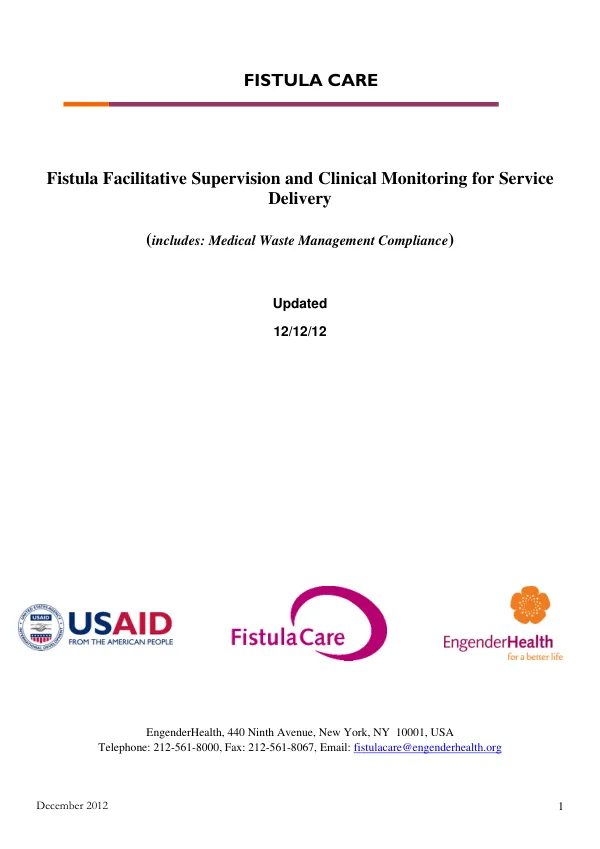
Fistula Facilitative Supervision and Clinical Monitoring for Service Delivery
Fistula Facilitative Supervision and Clinical Monitoring for Service Delivery is a document that outlines the assessment and evaluation of fistula care services at a facility.
2012 · 15 pages
Sign in to readA free account is required to download.
Abstract
The document is dated December 2012 and is a part of the Fistula Care project, which is supported by the Office of Maternal and Child Health, U.S. Agency for International Development (USAID). The assessment is conducted to evaluate the facility's fistula service delivery, including the availability of equipment, supplies, and medical drugs. The document also evaluates the facility's compliance with fistula service delivery guidelines, including client assessment, diagnosis, and classification, preoperative management, postoperative management, use of analgesia and/or anesthesia, management of complications, and safe management of labor and delivery. The facility's fistula service delivery is evaluated based on several indicators, including the availability of fistula repair sets and other support equipment, expendable supplies, medical drugs, and family planning methods. The document also evaluates the facility's waiting period for fistula treatment services, backlog of fistula treatment services, and fistula closure rate. The assessment reveals that the facility has a backlog of fistula treatment services, with 34 women awaiting treatment. The facility's fistula closure rate is 75%, which is below the target of 70%. The estimated complication rate in the last two full quarters is 10%. The facility has a dedicated operating theater day every week, and the number of fistula repairs in the last two full quarters is 20. The document also evaluates the facility's compliance with fistula service delivery guidelines, including client assessment, diagnosis, and classification, preoperative management, postoperative management, use of analgesia and/or anesthesia, management of complications, and safe management of labor and delivery. The facility's compliance with these guidelines is generally good, but there are some areas for improvement. The assessment also evaluates the facility's availability of policy documents, HMIS, and job aids. The facility has fistula care policy or strategy documents, reference materials, and job aids, but some of these documents are not maintained in good condition. The document concludes that the facility has some areas for improvement in its fistula service delivery, including reducing the backlog of fistula treatment services, improving the fistula closure rate, and increasing the availability of medical drugs and family planning methods. The facility should also improve its compliance with fistula service delivery guidelines and maintain its policy documents, HMIS, and job aids in good condition. The facility's fistula service delivery is critical to the health and well-being of women who suffer from fistula. The assessment and evaluation of fistula care services at the facility are essential to identify areas for improvement and to ensure that the facility provides high-quality fistula care services to women in need.
Related documents