USAID DEC
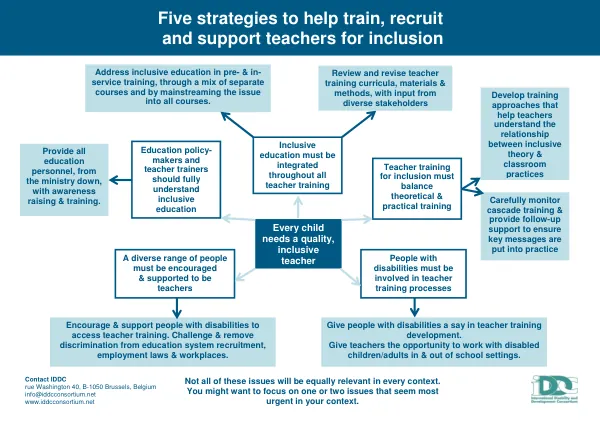
Five Strategies to Help Train, Recruit and Support Teachers for Inclusion
Inclusive education is a critical component of quality education, and teachers play a vital role in ensuring that every child receives an inclusive education.
1 pages
Sign in to readA free account is required to download.
Abstract
Education policymakers and teacher trainers must have a comprehensive understanding of inclusive education to effectively support teachers in this endeavor. Inclusive education must be integrated throughout all teacher training programs to ensure that teachers are equipped with the necessary skills and knowledge to create inclusive learning environments. Teacher training for inclusion must strike a balance between theoretical and practical training, enabling teachers to apply theoretical concepts to real-world classroom situations. People with disabilities must be actively involved in teacher training processes to provide valuable insights and perspectives. A diverse range of people must be encouraged and supported to become teachers, promoting diversity and representation in the teaching profession. To promote inclusive education, education personnel, from the ministry down, require awareness-raising and training. This includes addressing inclusive education in pre- and in-service training through a mix of separate courses and mainstreaming the issue into all courses. Teacher training curricula, materials, and methods must be reviewed and revised with input from diverse stakeholders to ensure that they are inclusive and effective. Developing training approaches that help teachers understand the relationship between inclusive theory and classroom practices is essential. This can be achieved by carefully monitoring cascade training and providing follow-up support to ensure that key messages are put into practice. People with disabilities must be given a say in teacher training development, and teachers must be given opportunities to work with disabled children and adults in and out of school settings. Encouraging and supporting people with disabilities to access teacher training is also crucial. This involves challenging and removing discrimination from education system recruitment, employment laws, and workplaces. While not all of these issues may be equally relevant in every context, focusing on one or two urgent issues can help address the most pressing needs.
Related documents