USAID DEC
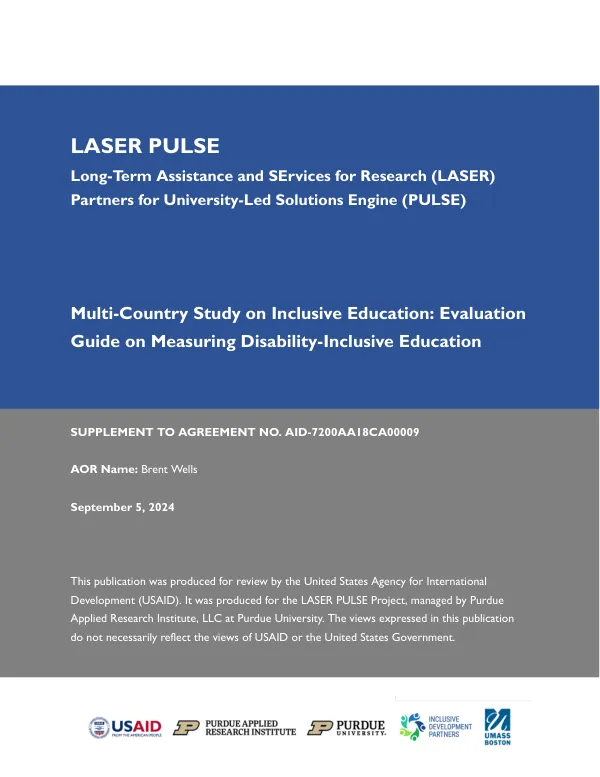
Multi-Country Study on Inclusive Education: Evaluation Guide on Measuring Disability-Inclusive Education
Sign inCATHOLIC RELIEF SERVICES ORGANIZATION
Multi-Country Study on Inclusive Education: Evaluation Guide on Measuring Disability-Inclusive Education
The Multi-Country Study on Inclusive Education (MCSIE) is a research initiative aimed at improving disability-inclusive education programming globally.
2024 · 50 pages
Sign in to readA free account is required to download.
Abstract
The study was conducted in Cambodia, Malawi, and Nepal, and its findings are presented in the Evaluation Guide on Disability-Inclusive Education. The guide is designed to help USAID and its partners inform existing and future disability-inclusive programming across the learning and education continuum. The guide presents information and recommendations on how to collect, monitor, and evaluate data on learners with disabilities. It draws on the lessons learned from the MCSIE study, which identified key challenges and opportunities for improving disability-inclusive education. The guide provides a conceptual framework for understanding disability-inclusive education and offers practical guidance on monitoring and evaluation (M&E) practices. The guide emphasizes the importance of engaging advisors and partners with expertise in disability measurement and assessing the landscape of disability within a country's context. It also provides guidance on formulating project goals and intended outcomes with considerations for disability inclusion and measuring disability-inclusive education through Collaborating, Learning, and Adapting (CLA) practices. The guide highlights the need for budgeting for disability-inclusive education in M&E and provides a checklist for inclusive budgeting. It also offers guidance on conducting labor market assessments and learning outcomes assessments. The guide includes annexes with additional resources, such as a checklist for consulting local organizations of persons with disabilities and considerations for learning outcomes assessments. The MCSIE study was conducted by Inclusive Development Partners (IDP) in partnership with Kathmandu University, the Cambodian Disabled Persons Organization, and Invest in Knowledge. The study was supported by USAID's Center for Education and the LASER PULSE program. The guide is a valuable resource for USAID and its partners seeking to improve disability-inclusive education programming globally. The guide is structured around several key themes, including the conceptual framework for disability-inclusive education, monitoring and evaluation of disability-inclusive education, and budgeting for disability-inclusive education. It provides a comprehensive overview of the key challenges and opportunities for improving disability-inclusive education and offers practical guidance on M&E practices. The guide includes a range of annexes and exhibits that provide additional information and resources on disability-inclusive education. These include models of disability, the twin-track approach to disability-inclusive education programming, and outcome areas for disability-inclusive education programming. The guide also includes a list of references and a table of exhibits. Overall, the Evaluation Guide on Disability-Inclusive Education is a valuable resource for USAID and its partners seeking to improve disability-inclusive education programming globally. It provides a comprehensive overview of the key challenges and opportunities for improving disability-inclusive education and offers practical guidance on M&E practices.