WORLD BANK
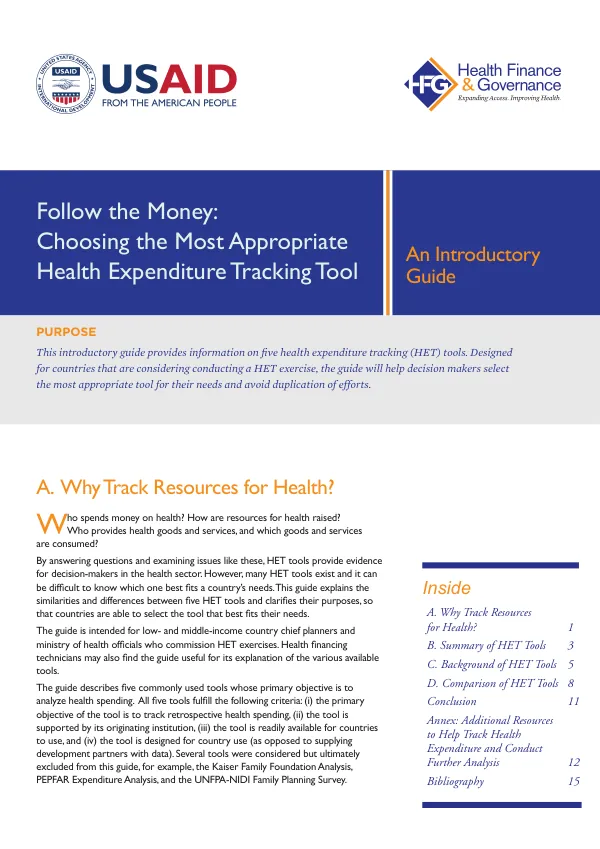
Follow the Money: Choosing the Most Appropriate Health Expenditure Tracking Tool
Health expenditure tracking (HET) tools are essential for countries to manage their health spending effectively.
2018 · 16 pages
Sign in to readA free account is required to download.
Abstract
These tools provide evidence for decision-makers in the health sector by answering questions such as who spends money on health, how resources for health are raised, and which goods and services are consumed. However, with many HET tools available, it can be challenging for countries to select the most appropriate tool for their needs. The guide explains the similarities and differences between five commonly used HET tools, including the Public Expenditure Review for Health (PER-Health), Public Expenditure Tracking Survey for Health (PETS-Health), Health Accounts/System of Health Accounts 2011 (SHA 2011), Joint Reporting Form-Immunization (JRF), and National AIDS Spending Assessment (NASA). Each tool has a unique perspective and provides information to answer unique policy questions. The PER-Health tool, developed by the World Bank, evaluates the efficiency, effectiveness, equity, and sustainability of government-managed health spending. It assesses spending against parameters of allocative efficiency, technical efficiency, and transparency of government spending. The PER guidelines do not require a standard set of classifications, giving countries flexibility but also making it challenging to compare results over time or with other countries. The PETS-Health tool, also developed by the World Bank, tracks the flow of publicly managed resources from the central government down to the final goods and services provided by healthcare providers. It is often used in conjunction with the Quantitative Service Delivery Survey to assess expenditure at the facility level and understand efficiency of service delivery. Health Accounts/SHA 2011 tracks total health system expenditures across three dimensions that describe how funds are mobilized, managed, and used to purchase and deliver health goods and services. It captures health spending for immunization and HIV, as well as non-health spending. The JRF tool tracks national immunization coverage in WHO Member States, focusing on immunization spending via six specific indicators. The NASA tool tracks spending on the HIV response across three dimensions that describe how funds are mobilized, managed, and used to purchase/deliver health and non-health goods and services related to HIV. Countries can only manage health spending they can measure. Therefore, it is essential to select the most appropriate HET tool for their needs. The guide provides a high-level comparison of the tools, based on the information they generate for decision-making, and considerations for implementing the tools in practice.