USAID. MISSION TO HAITI
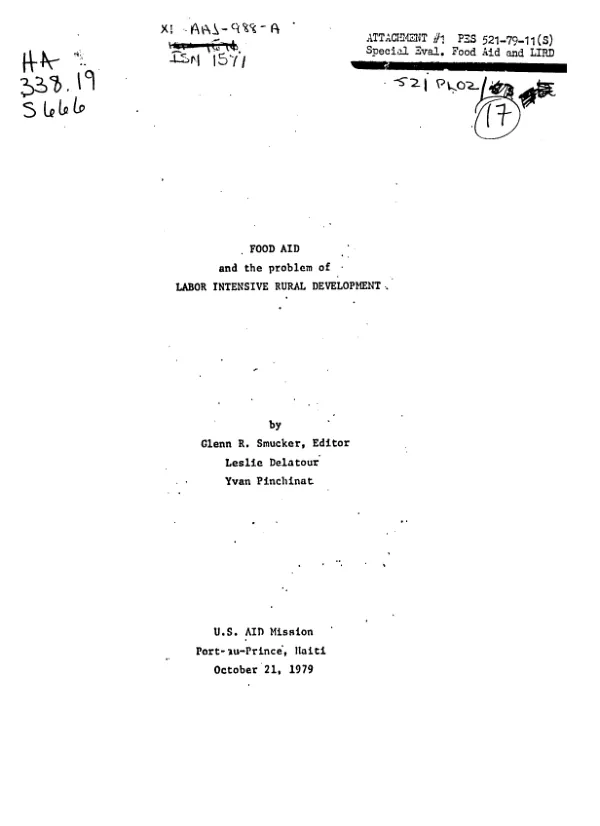
Food aid and the problem of labor intensive rural development
Evaluates P.L.
Smucker, Glenn R.; Delatour, Leslie +1 more · 1979
Sign in to readA free account is required to download.
Abstract
480, Title II Food For Work (FFW) program in Haiti. Special evaluation covers the period through 9/79 and is based on site visits to Fond des Negres, Kenscoff, La Gonave, and Terre Newe (detailed case studies included) and on interviews with government, project, and PVO personnel and with benificiaries and residents. Haiti"s experience has shown that food aid is at best a stopgap measure. Rising food imports, more commercial than concessionary, have not prevented rising food prices. While farmers are growing more food, they are also becoming dependent on food aid. Peasants, as consumers, view FFW commodities as in-kind wages rather than incentives; they consume some and rationally but illegally sell the rest. Although appearing somewhat more democratic than cash payment projects, FFW projects tend to lack sufficient technical support and administrative control, especially on the part of community councils. Both lend themselves to corruption, contribute to creation of a patronage system, and commonly suffer payment delays. It is thus concluded that: (1) FFW projects should be of limited duration and geared to seasonal changes in grain prices and labor demand; (2) small projects are more efficient and less vulnerable to abuse; (3) delayed and irregular food disbursements foster corruption; (4) workers should have an intrinsic interest in the asset being developed; (5) contracted projects increase efficiency but have greater potential for abuse; (6) flexibility (e.g., distributing rations for home use versus cooked meals on the job) is important; (7) when used as investment, food might best be combined with other inputs (cash, goods, etc.), but PVO"s should not expand beyond their ability to manage such inputs; (8) the price of P.L. 480 commodities sold in markets should be monitored; and (9) the problem of dependency will be solved only with the rise of peasant institutions that can balance the need for relief and economic self-sufficiency. Further research is needed on the market effects of P.L. 480 commodities in isolated sites, differences between development and relief projects, the background and potential of community councils and alternative bodies, and the input needs of peasant households.
Related documents