USAID. BUR. FOR POLICY AND PROGRAM COORDINATION. CENTER FOR DEVELOPMENT INFORMATION AND EVALUATION (CDIE)
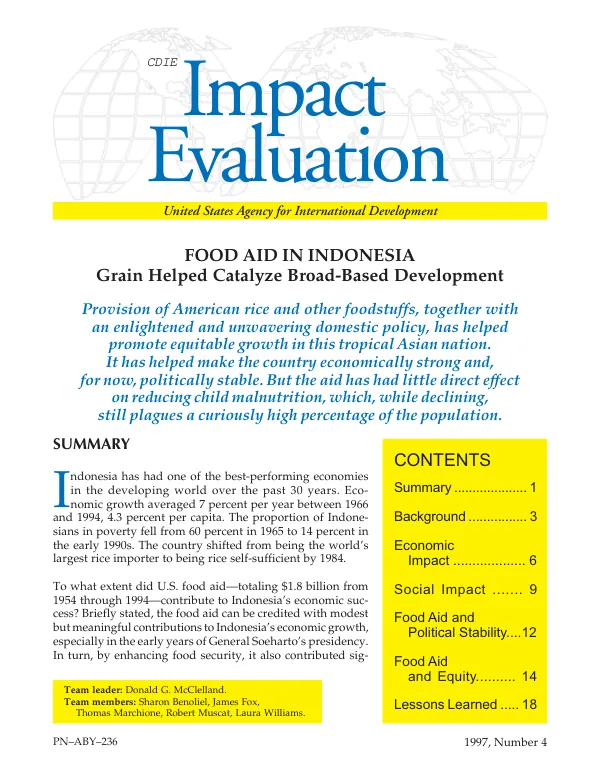
Food aid in Indonesia : grain helped catalyze broad-based development
To what extent did U.S.
McClelland, Donald G.|Benoliel, Sharon · 1996
Sign in to readA free account is required to download.
Abstract
food aid -- totaling $1.8 billion from 1954 through 1994 -- contribute to Indonesia's economic success in the last 30 years? The answer to this question varies across three distinct time periods. From 1954 through 1965, during President Sukarno's tenure, there is no evidence food aid helped improve Indonesia's economy. However, during the early Soeharto period (1966-73), food aid played a major role in supporting the reform efforts of the new president's economic team and substantially helped augment Indonesia's hard currency reserves. Food aid again became marginal after 1974, when Indonesia's oil revenues increased. The benefits of economic growth have been widely shared in Indonesia, and the Soeharto government's growth strategy was central to this achievement. Its highest priorities were to increase food production, maintain stable rice prices (at a level higher than world prices), and invest in rural infrastructure. Initially, the beneficiaries were poor smallholders, largely rice producers; over time, the majority of low-income people benefitted. Indonesia under Soeharto refused to resort to deficit financing. That meant that local currency generated from Title I sales provided critical additional spending for development purposes. Had these funds not been available, the development budget would have been reduced by a like amount -- as much as one third in the early 1970s. Much of that money was invested in activities with a high payoff (green revolution technology together with irrigation facilities and rural roads) that led to increased rice yields. The Title II food-for-work program was also successful. It supported labor-intensive rural infrastructure development in the late 1960s and early 1970s. These village-based activities encouraged public investment that favored poor people and poor areas. As a result, Indonesia's peripheral regions felt they were participating in the country's overall development. When oil revenues began pouring in during the mid-1970s, this model was transformed into the "Inpres" program, a government-supported cash-for-work program. This major effort has been credited with creating rural prosperity by generating income and by improving infrastructure. In Indonesia, rice is critical to political stability. In 1965, rice production in Java was no higher than before World War II, and per capita rice consumption had fallen 15% since 1960. U.S. rice provided under P.L. 480 in the precarious post-Sukarno years was vital. It helped close the cereals gap and maintain rice price stability. On the down side, the direct impact of U.S. food aid on child malnutrition appears limited, except in the most severe cases. However, food aid may have helped indirectly improve nutritional status of children under 5 with mild to moderate malnutrition by encouraging mothers to attend integrated village health posts. Several lessons can be learned from the experience of U.S. food assistance in Indonesia. (1) Food aid can make a significant contribution to sustainable development when provided in support of a sound macroeconomic environment. (2) Local currency generated from the sale of food aid can contribute to sustainable development when the money is used to support a sound, development-oriented budget or when qualified NGOs use the money to fund high-priority development activities. (3) When political stability in the short run depends on an adequate food supply at reasonable prices, food aid can provide the critical margin. (4) Food aid can be an important vehicle for supporting growth strategies and public resource transfers that differentially benefit lower income groups. (5) In the short term, food aid appeared to contribute indirectly to nutritional improvement by stimulating attendance at community health posts in poor communities. (6) Food aid is not always a reliable source of food; some food aid commodities, unknown in the recipient country, may be accepted only reluctantly.