INTERNATIONAL MONETARY FUND
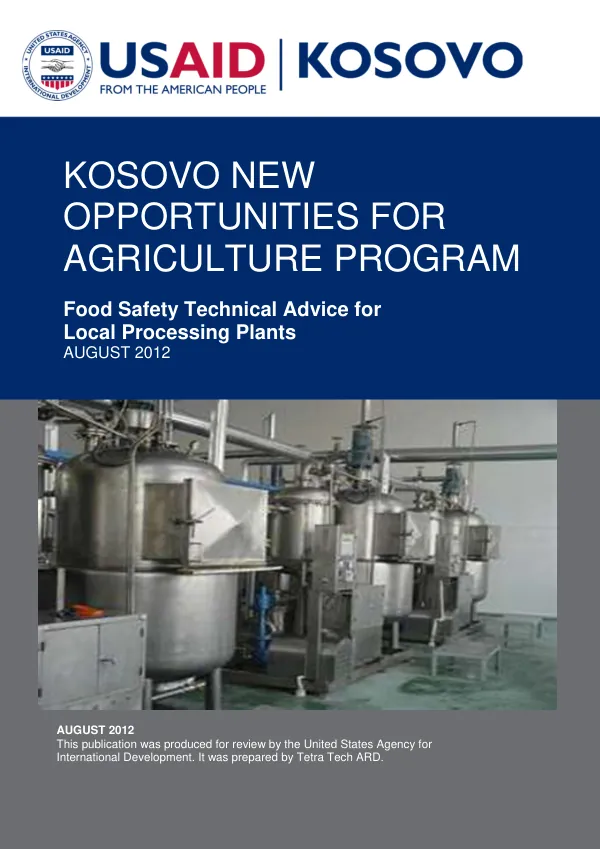
Food Safety Technical Advice for Local Processing Plants
The New Opportunities for Agriculture (NOA) program in Kosovo aims to increase economic growth through expanded, environmentally sustainable production and sales of value-added agricultural products.
2012 · 16 pages
Sign in to readA free account is required to download.
Abstract
The program has five components: linking products and farmers with markets, diversifying and increasing agricultural products, improving food quality and safety, increasing affordable and accessible credits, and improving coordination within the agriculture sector. The NOA program conducted a four-day HACCP training course for local fruit and vegetable processing companies in March 2012. Twelve representatives from different local processing companies attended the training, led by Vladimir Kokarev, a HACCP expert based in neighboring Macedonia. Following the training, three further processors are now discussing with the program future technical assistance required for HACCP certification. The three selected companies, Abi & Elif 19, Sole Koral, and As Promet, account for a significant proportion of Kosovo's food processing sector. The companies have specific assistance requirements and share different processing requirements, which necessitate the preparation of detailed analyses of their existing and future plans. These analyses can lead to subsequent alterations and adaptations to ensure all plant construction fulfills HACCP food safety standard requirements. The visits to the companies underscored the need to implement HACCP system standards and the need for continued training of employees. The engagement highlighted the importance of educated staff with practical experience, particularly in food technologists and employees with laboratory experience. Most university graduates have theoretical knowledge but little practical experience in food processing and food safety. Investments in education and training involve a long process, but no factory can deliver safe, quality products and become a serious export-oriented company without a clear strategy for human resources. The proper adaptation of facilities and the use of proper equipment will eliminate the possibility of contamination. The training and education of workers, and the establishment of laboratories within processing companies, will enable the complete control of all plant processes, starting from the receiving of raw materials, through processing, packing, and distribution of finished products. Meetings were held with key players within the industry in Kosovo, including Sole Koral, a fast-growing company that has invested in the processing and production industries. The company showed serious interest in cooperating in the implementation of all relevant food-safety standards and adopting the latest in processing technology and know-how. Abi & Elif 19, among the oldest companies in the processing sector, is seeking to build a new facility, as the cost of maintaining the current facility is becoming increasingly high. The NOA program aims to support the development of a safe and healthy food processing industry in Kosovo. The program's efforts focus on providing technical assistance to local processing companies to help them meet international food safety standards. The program's goal is to increase the competitiveness of Kosovo's food processing sector and to improve the quality and safety of food products.