TETRA TECH ARD, INC.
Kosovo New Opportunities for Agriculture Quarterly Report January-March 2012
The Kosovo New Opportunities for Agriculture Program is a USAID-funded initiative aimed at improving agricultural productivity and diversifying agricultural products in Kosovo.
2012 · 41 pages
Sign in to readA free account is required to download.
Abstract
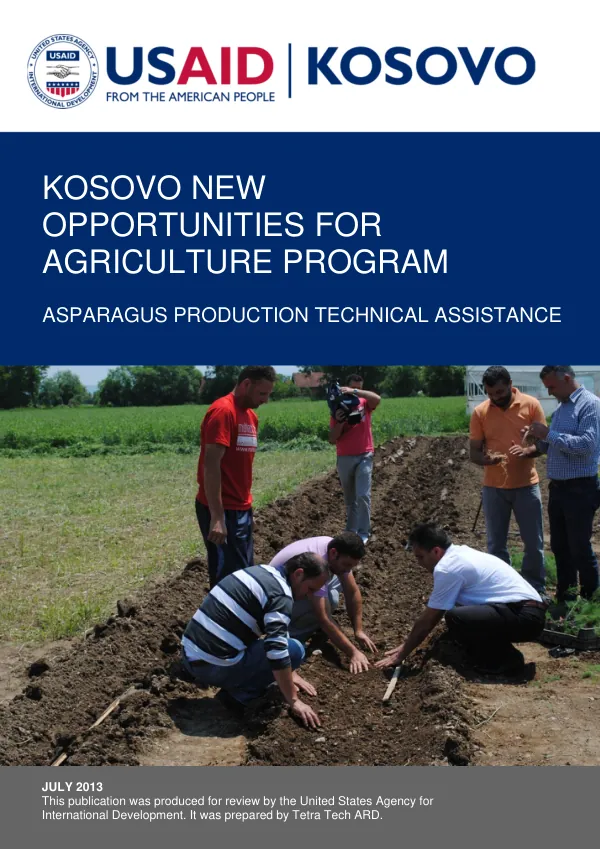
The program's second specific objective is to increase the diversity and quantity of agricultural products. To achieve this, the program has awarded grants to participating farmers for the growth of new varieties of fruits and vegetables, including apples, table grapes, strawberries, raspberries, and blueberries. In the second quarter of 2012, the program's team focused on preparing grantees for implementing the grants awarded in the first quarter. Trainings were provided in Integrated Pest Management (IPM) and the importance of following the recommendations of the PERSUAP report. Soil analyses were conducted on all grantees' farms before grants were confirmed, and recommendations were made for enhancing soil conditions where necessary. The program also supervised the preparation of trial plots to ensure they were ready for receiving and planting imported materials. In March, the first shipment of imported plants, including blueberries from the US, arrived in Kosovo and were distributed to four growing grantees. Apple and table grape rootstocks arrived from Italy, and strawberries and raspberries ordered from the UK were shipped at the end of March with an expected arrival date of April 11. The program invested over $400,000 in importing these materials, which represent an investment by USAID and the American people. The subcontracts to a local business service provider, Rural Development Center, for supervising the trial plantings of new varieties of lettuce and gherkins were extended for another season. This year, there are 12 lettuce producers and 23 gherkin producers being supervised, with a focus on increasing yields and introducing new varieties of lettuce to provide a longer sales season. The asparagus seedlings, which had been winterized at three nurseries over the winter, had developed good crowns and 90,000 were prepared for distribution to growing grantees. The program received seven applications from farmers interested in growing asparagus and expects to award the crowns to six farmers with the right soil conditions and willingness to invest in a product that will not provide revenue for another two to three years. The program also ordered another 240,000 seeds in February to develop into seedlings for planting 8 ha in 2013. The plans to introduce new anti-hail technology into apple orchards moved ahead after resolution of several issues concerning the sourcing of such materials. One system was purchased from Serbia under the SEED waiver, and waivers were obtained to purchase two systems from Austria and Italy. An order for a new system of Vee-style trellising to support the imported table grapes was shipped from the US with an expected arrival of late April. Attention has been given to preparing growers and supervising grantees for introducing IPM at the grantees' farms. Separate classroom trainings have been delivered to growers of the main crops being managed by the program, and manuals have been written for each crop. These trainings are being followed in the next quarter by in-field trainings to demonstrate monitoring, sampling, and pest identification techniques. In February, Dr. Alan Schroeder, the author of the program's PERSUAP report, gave three days of training on the Safe Use of Pesticides and Environmental Protection to a group including representatives of the supervising grantees, the MAFRD Extension Service, and spraying service providers. The training covered topics on the regulatory and certification environments, and guidelines for what to do and when for each crop. The program has also begun to focus on the processing of crops, with the introduction of Hazard Analysis and Critical Control Points (HACCP) seen as furthering two objectives of the program: to improve food safety and quality and to diversify agricultural products. There is much scope for Kosovo to process more of the products it grows within Kosovo, thereby reducing imports and expanding employment in the sector.