USAID
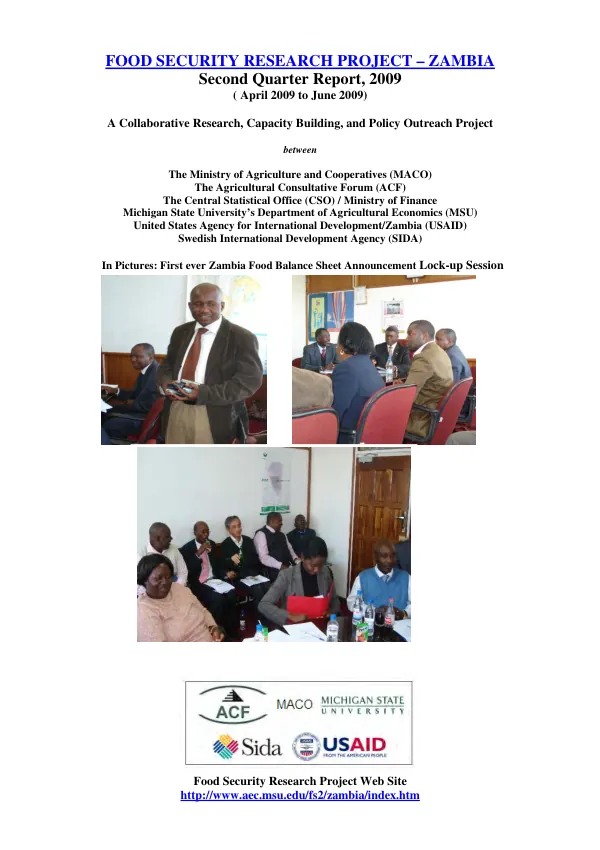
FOOD SECURITY RESEARCH PROJECT - ZAMBIA Second Quarter Report, 2009
Land access, land tenure, and poverty dynamics in rural Zambia are critical issues that require attention from policymakers.
2009 · 16 pages
Sign in to readA free account is required to download.
Abstract
The study "Access to Land, Poverty Reduction in Rural Zambia: Connecting the Policy Issues" has been finalized and updated as working paper number 34. The research highlights the challenges faced by rural communities in accessing land, which hinders their ability to reduce poverty. The study emphasizes the need for policy strategies to address these land constraints and ensure that rural communities have secure access to land. The Food Security Research Project (FSRP) has been actively involved in outreach activities with relevant stakeholders, utilizing the study's findings to inform policy discussions. The upcoming Ministers' retreat will focus on addressing the issue of land constraints and their impact on poverty reduction objectives. The FSRP will continue to engage with policymakers and stakeholders to ensure that the research findings are integrated into policy decisions. The FSRP has also initiated work on a study to evaluate the returns to research on sweet potato and cassava. The study aims to assess the rate of return on past research investments in these crops. The research will be conducted in collaboration with the Zambia Agricultural Research Institute (ZARI) and the Food Crop Diversification Support Project (FoDiS). The study will evaluate the yield gains under improved varieties and provide recommendations for future research investments. In addition, the FSRP has commenced data collection for a study on the impact of rural roads investment on smallholder livelihoods in Zambia. The research will involve household analysis and will be conducted in collaboration with the Road Development Agency and the Central Statistical Office (CSO). The study aims to provide insights into the impact of rural roads investment on poverty reduction and poverty reduction strategies. The FSRP has also updated the ACF/FSRP website to include a new subheading containing documents related to the returns to research on sweet potato and cassava. The website will serve as a platform for disseminating research findings and research findings will be made available to stakeholders. The FSRP's main base is its office in Lusaka, where research fellows and research specialists collaborate with Michigan State University (MSU) campus staff on analysis and outreach efforts. The FSRP's research and outreach activities are guided by the semi-annual Advisory Board consultations, which include representatives from the Ministry of Agriculture and Cooperatives (MACO), the Agricultural Consultative Forum (ACF), the Central Statistical Office (CSO), and the United States Agency for International Development (USAID). The FSRP's research and outreach activities are focused on strengthening the capacity of local institutions and government agencies responsible for food security in Zambia. The project aims to strengthen the capacity of MACO, the Ministry of Finance and National Development, and the Ministry of Commerce, Trade, and Industry to conduct research on national food security issues. The FSRP also aims to strengthen the Central Statistical Office (CSO) to carry out data collection, data management, and data analysis, and perform analyses useful to policymakers. The FSRP's research and outreach activities are guided by the "joint products" approach, which involves collaborative work with in-country stakeholders and government counterparts. The approach aims to achieve broad results, including capacity building for local Zambian counterparts, applied research, and policy outreach. The FSRP's research and outreach activities are focused on promoting agricultural growth, improving food security, and reducing poverty in Zambia. The FSRP's research and outreach activities are supported by a team of researchers and research specialists from MSU, who collaborate with in-country stakeholders and government counterparts to achieve the project's objectives. The FSRP's research and outreach activities are guided by the project's semi-annual Advisory Board consultations, which include representatives from MACO, ACF, CSO, and USAID.
Related documents