CNFA, INC.
Amalima CNFA FFP-A-13-00004: Final Report FY 2018
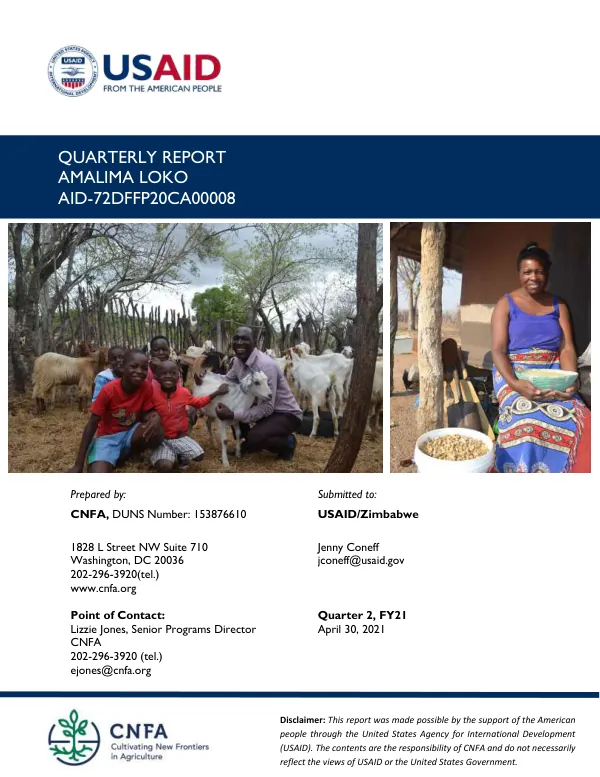
The Amalima program promotes resilience and food and nutrition security for 95,536 direct participants in four rural districts of the Matabeleland region in southern Zimbabwe.
2018 · 33 pages
Sign in to readA free account is required to download.
Abstract
The program aims to sustainably improve household nutrition and food security and strengthen communities' resilience to shocks by leveraging communal initiatives to increase productivity, improve drought mitigation and adaptation, and enhance nutrition and hygiene practices. Matabeleland is an arid region with low average rainfall and limited surface water sources. Amalima provides improved access to water by rehabilitating and constructing dams, abstracting water from river beds, and promoting technologies that conserve moisture. This contributes to enhanced productivity and production, leading to improved access and availability of food. The reporting year saw poorer than average rainfall, with a prolonged dry spell in the middle of the season, resulting in low harvests of staple grains and an increase in food insecurity. Amalima has prioritized building the capacity of water user committees, also known as Asset Management Committees (AMC), to encourage proper maintenance of the assets. The program trained 35 garden groups and AMCs for dams on sustainable maintenance and management of water resources. User groups and AMCs were also encouraged to develop user funds to support infrastructure maintenance and for the purchase of input/spares replacement. For irrigation schemes, a total of 464 people participated in the training, which focused on building AMC and user's skills in conducting repair and maintenance works on their sand abstraction hand pumps and garden water supply systems. The Amalima Results Framework has not changed, but the program has refined its approaches to focus on cost recovery, volunteer recognition and motivation, and support from and linkages to government and traditional leaders. Notable changes include the promotion of selected high-performing lead farmers to become Village Agriculture Coordinators (VACs) and the introduction of Amalima Days, large community-led events that highlight key activities and achievements across Strategic Objectives, including health and nutrition, and publicly recognize the contributions of community volunteers and the support of traditional leaders and government technical officers. The program has made significant progress in improving household access to and availability of food. The number of households with improved access to water for agriculture and productive use is 12,655, and this number will increase in FY19 once construction and rehabilitation for assets that began in FY18 is complete. Amalima has also prioritized building the capacity of water user committees to encourage proper maintenance of the assets, and the program has trained 35 garden groups and AMCs for dams on sustainable maintenance and management of water resources. The Amalima program has also made progress in improving community resilience to shocks. The program has promoted selected high-performing lead farmers to become Village Agriculture Coordinators (VACs), and the introduction of Amalima Days has helped to highlight key activities and achievements across Strategic Objectives, including health and nutrition, and publicly recognize the contributions of community volunteers and the support of traditional leaders and government technical officers. The program has also made progress in improving nutrition and health among pregnant and lactating women (PLW) and boys and girls under 2. Amalima has promoted selected high-performing lead farmers to become Village Agriculture Coordinators (VACs), and the introduction of Amalima Days has helped to highlight key activities and achievements across Strategic Objectives, including health and nutrition, and publicly recognize the contributions of community volunteers and the support of traditional leaders and government technical officers. The Amalima program has faced several challenges, including the national outbreak of fall army worm in Matabeleland, which severely affected maize in irrigation schemes. However, the dry spell limited the overall impact of the outbreak. The program has also faced challenges related to the economic crisis in Zimbabwe, including cash shortages and inflation. However, the Amalima districts, being near the border with Botswana and South Africa, were somewhat insulated from the crisis as goods flow across the borders and households often receive remittances in South African Rand. Overall, the Amalima program has made significant progress in promoting resilience and food and nutrition security for 95,536 direct participants in four rural districts of the Matabeleland region in southern Zimbabwe. The program has prioritized building the capacity of water user committees, promoting selected high-performing lead farmers to become Village Agriculture Coordinators (VACs), and introducing Amalima Days to highlight key activities and achievements across Strategic Objectives, including health and nutrition, and publicly recognize the contributions of community volunteers and the support of traditional leaders and government technical officers.
Related documents