INTERNATIONAL FOOD POLICY RESEARCH INSTITUTE (IFPRI)
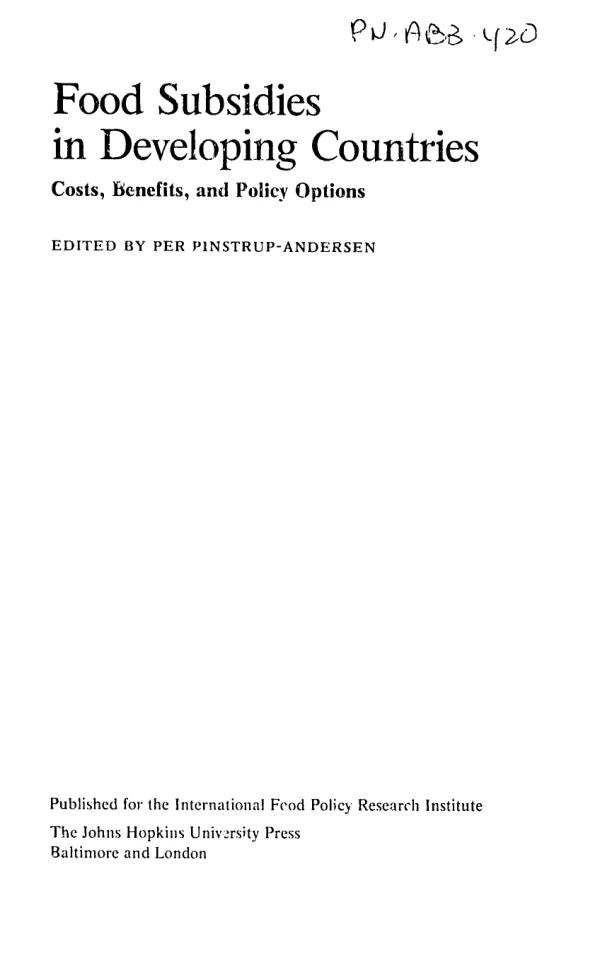
Food subsidies in developing countries : costs, benefits, and policy options
Consumer-oriented food subsidies are used widely throughout the developing world, albeit for a diversity of objectives.
Pinstrup-Andersen, Per, ed. · 1970
Sign in to readA free account is required to download.
Abstract
Subsidy programs may aim to improve the real purchasing power of all or certain groups of consumers, reduce or eliminate calorie and nutrient deficiencies in low-income population groups, maintain low urban wages, or assure social and political stability. Part I of this report provides an overview of the major costs and benefits associated with consumer-oriented food subsidies, while Part II reviews their effect on household incomes, income distribution, food consumption, and nutritional status among low-income population groups. Implications for the agricultural sector and for foreign trade, government expenditures, inflation, and other macro-economic factors are discussed. Part II also covers related political considerations and lessons for program and policy implementation and discusses alternatives to food subsidies. Results from country studies conducted in Egypt, the Philippines, Bangladesh, India, Pakistan, Sri Lanka, Brazil, Mexico, and Zambia are presented in Part III, while the last section discusses the implications of these findings for current and future food policies at both the micro- and macro-levels. The most important lesson emerging from the report is that consumer food subsidies can be a powerful and cost-effective policy tool to reach certain social, economic, and political goals, or they can be harmful to growth and equity. As with many other policy tools, the question is not whether consumer food subsidies are good or bad but when and how they are applied.