USAID. BUR. FOR SCIENCE AND TECHNOLOGY. OFC. OF FORESTRY, ENVIRONMENT AND NATURAL RESOURCES
Forest resources management (FRM)
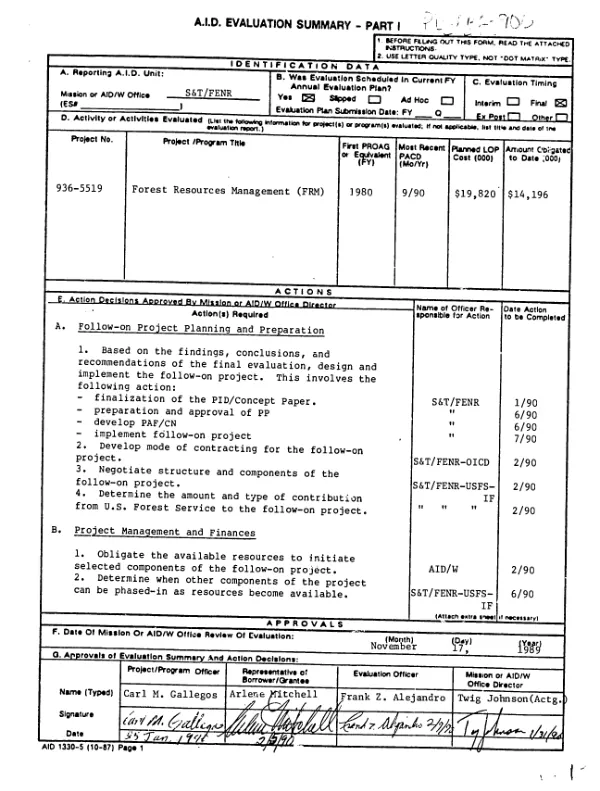
Summarizes final evaluation (unattached) of a project to provide TA to developing countries for the establishment of effective forestry programs.
1990
Sign in to readA free account is required to download.
Abstract
The project was implemented by the U.S. Forest Service (FS), the U.S. Department of Agriculture"s Office of International Cooperation and Development, and the Peace Corps. Evaluation covered the period 8/80-9/90. The project was successful in delivering intended products, thereby influencing, directly or indirectly, A.I.D. operations in the forestry sector. A.I.D. and non-A.I.D. professionals knowledgeable about the project universally expressed a favorable attitude towards the project"s professional staff, the A.I.D.-FS institutional relationship, and the delivery of services. The clients for these services, i.e., A.I.D. Mission and regional personnel, expressed medium to high satisfaction with the project, and had a particularly high regard for its referral service and for the information contained in the monthly, quarterly, and special reports. Regional personnel were generally satisfied with the technical backstopping provided by the project, though some felt the project focused too much on detail and lacked a larger vision. Project management was professionally competent, greatly respected for the establishment and continuation of the project effort, and provided the correct balance between independence and direction. The project was a major source of continuity and institutional memory on matters regarding A.I.D. natural resource/forestry issues, practices, and lessons. A.I.D. Missions and Bureaus expressed a strong interest in the continuation of project activities. Technical support needs in forestry and renewable natural resources are increasing, and a diversifying agenda of assistance in forestry is creating additional support needs, e.g., agroforestry, social forestry, legal and policy aspects, etc. A follow-on project should include: (1) a more proactive role; (2) an expanded scope of programmatic studies that explore new initiatives, including all renewable natural resources that involve forested lands; and (3) studies of global and regional scope that address different themes and approaches to donor assistance in renewable natural resources management. (Author abstract, modified)
Related documents