THE AMERICAN INSTITUTES FOR RESEARCH
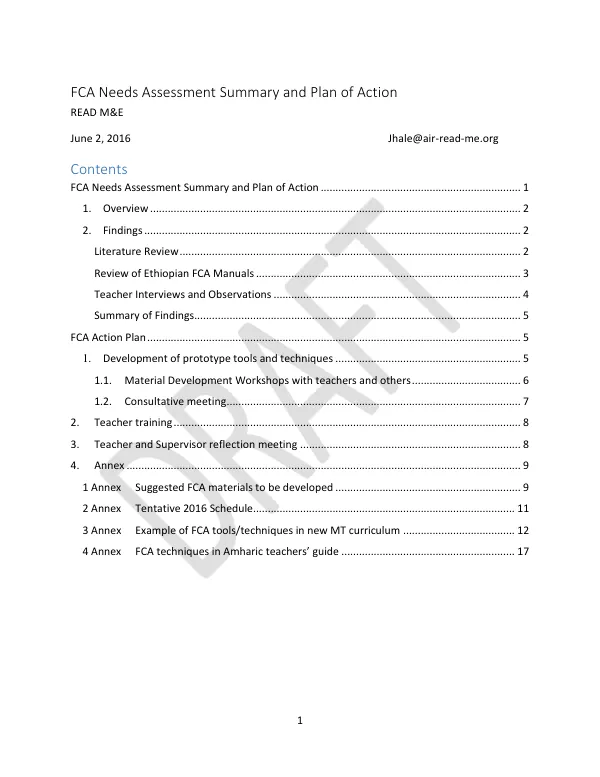
Formative Continuous Assessment: Literature Review and Mapping
The READ M&E formative continuous assessment literature review and mapping document was produced for review by the United States Agency for International Development.
2016 · 26 pages
Sign in to readA free account is required to download.
Abstract
The document was submitted by the American Institutes for Research and is based on an introductory review of the international literature around formative continuous assessment (FCA) in education. The review also includes a separate review of local Ethiopian formative continuous assessment manuals and guides produced and used in-country in recent years. The international FCA literature review matrix highlights key points for consideration when planning for formative assessment activities. The matrix includes definitions and purposes of FCA, challenges, successful approaches and practices, and lessons learned. The review emphasizes the importance of ongoing, diagnostic, classroom-based processes that use a variety of assessment tools to measure learner performance. It also highlights the need for sensitization of stakeholders, provision of materials and equipment, and monitoring of assessment practices. The review identifies several key challenges to implementing FCA, including large class sizes, continuous testing versus continuous assessment, perceived increased workload for teachers, and inadequate teacher monitoring and support. Successful approaches and practices include providing teachers with CA task booklets, continuous school-based in-service workshops, and equipping teachers with the required knowledge and skills in assessment designs and procedures. The review also highlights the importance of professional development on the topic of FCA, focusing on the purpose, use, and interpretation of formative assessments while considering the environment in which teachers operate. It emphasizes the need for teachers to understand the purpose of formative assessment, why formative assessment is essential to improving teaching and learning, and how to use formative assessment techniques and tools in the classroom. The document also includes a review of the literature on FCA in Ethiopia, which highlights the need for sensitization of stakeholders, provision of materials and equipment, and monitoring of assessment practices. The review emphasizes the importance of ongoing, diagnostic, classroom-based processes that use a variety of assessment tools to measure learner performance. The theory of change for the READ M&E project is not explicitly stated in the document, but it is implied that the project aims to improve teaching and learning in Ethiopia through the implementation of FCA. The next steps for the project are not explicitly stated, but it is implied that the project will continue to monitor and evaluate the implementation of FCA in Ethiopia. Overall, the READ M&E formative continuous assessment literature review and mapping document provides a comprehensive review of the international and Ethiopian literature on FCA. It highlights key points for consideration when planning for formative assessment activities and emphasizes the importance of ongoing, diagnostic, classroom-based processes that use a variety of assessment tools to measure learner performance.
Related documents