POPULATION REFERENCE BUREAU
Which Policies Promote a Demographic Dividend? An Evidence Review
The demographic dividend is a prospect for accelerated economic growth driven by a country's maturing age structure.
2019 · 12 pages
Sign in to readA free account is required to download.
Abstract
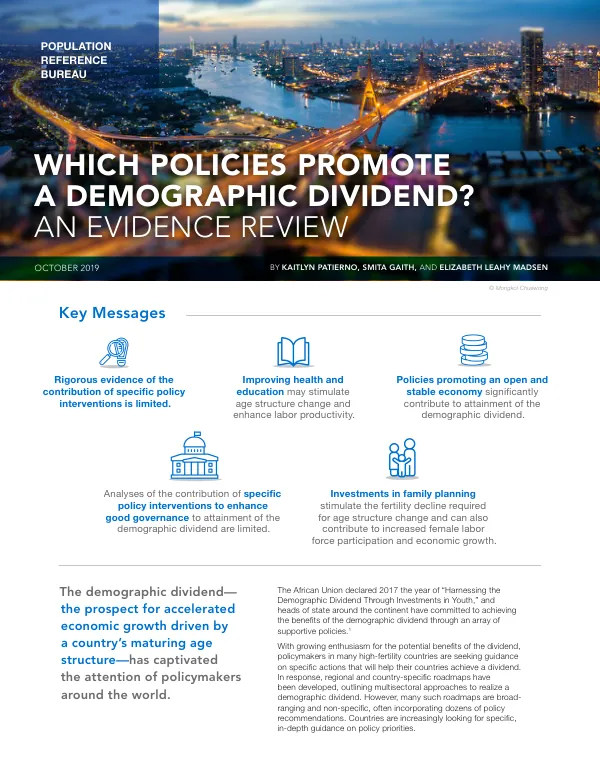
This phenomenon has captivated the attention of policymakers around the world, particularly in high-fertility countries seeking to achieve the benefits of the demographic dividend. The African Union declared 2017 the year of "Harnessing the Demographic Dividend Through Investments in Youth," and heads of state around the continent have committed to achieving the benefits of the demographic dividend through supportive policies. Improving health and education may stimulate age structure change and enhance labor productivity. Policies promoting an open and stable economy significantly contribute to attainment of the demographic dividend. The demographic transition is the long-term shift in birth and death rates from high to low levels in a population, resulting in a favorable age structure that can lead to a demographic dividend. The United Nations Population Division estimates that the window of opportunity for a demographic dividend opens when the share of the population under age 15 falls below 30 percent. Investments in family planning stimulate the fertility decline required for age structure change and can also contribute to increased female labor force participation and economic growth. However, rigorous evidence of the contribution of specific policy interventions is limited. The literature review conducted by Kaitlyn Patierno, Smita Gaith, and Elizabeth Leahy Madsen aimed to address this gap by assessing the literature on specific policy interventions across sectors that explicitly contribute to achieving a demographic dividend. The review identified a few policy priorities that are grounded in evidence, some of which promote the demographic transition that is required to attain a favorable age structure, while others help countries capitalize on and convert a favorable age structure into an economic boost. However, it is clear that more research is needed to assess the impact of specific policy changes in countries that successfully achieved a demographic dividend. Further efforts to evaluate the effectiveness of policy interventions will enable decisionmakers in high-fertility countries to identify and prioritize discrete policy and program investments that improve their own countries' likelihood of attaining the dividend. The review focused on the literature around policy interventions that support or inhibit attainment of the "first dividend." The studies meeting the inclusion criteria were summarized in the Annex, and the review highlighted the importance of improvements in health, education, the macroeconomic environment, and good governance for attaining the demographic dividend. The findings suggest that evidence quantifying the contribution of various policy interventions to attain the demographic dividend is limited, and more research is needed to address this gap.