USAID DEC
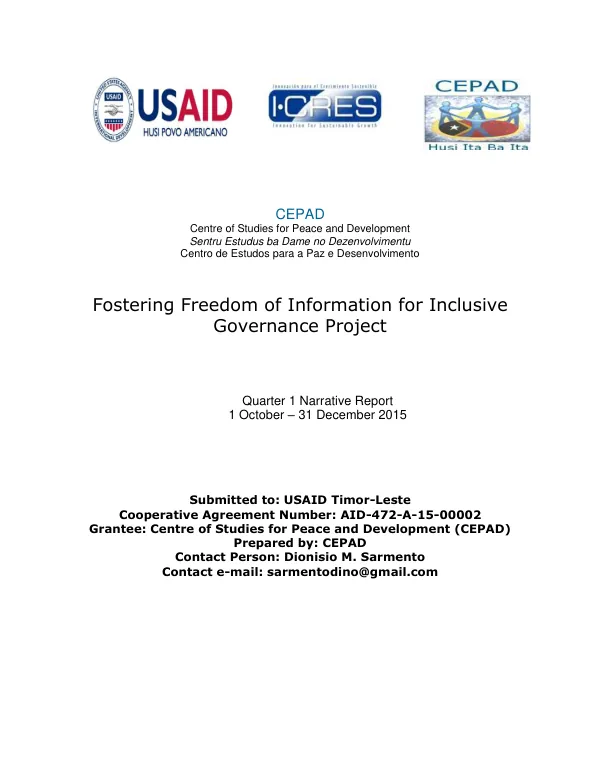
Fostering Freedom of Information for Inclusive Governance Project: Quarter 1 Narrative Report
Sign inUSAID DEC
Fostering Freedom of Information for Inclusive Governance Project: Quarter 1 Narrative Report
The Fostering Freedom of Information for Inclusive Governance Project, implemented by the Centre of Studies for Peace and Development (CEPAD), aims to promote transparency and accountability in Timor-Leste.
2015 · 54 pages
Sign in to readA free account is required to download.
Abstract
The project is funded by the United States Agency for International Development (USAID) under the Cooperative Agreement Number AID-472-A-15-00002. The project's objectives include enhancing the capacity of CEPAD to implement the project, promoting transparency and accountability in the government, and fostering a culture of openness and participation among citizens. To achieve these objectives, CEPAD has undertaken several activities during the first quarter of the project. One of the key activities was the research and compilation of local legislation and international commitments of Timor-Leste concerning access to public information. This activity was completed in November and December 2015, with the assistance of I-CRES consultant. The research aimed to identify the existing laws and regulations related to access to information in Timor-Leste. Another activity was the identification and analysis of international best practice examples for the right to information. This activity was also completed in November and December 2015, with the assistance of I-CRES consultant. The analysis aimed to identify successful models of access to information in other countries and to adapt them to the Timorese context. CEPD has also brought into place Dionisio M. Sarmento as the Outreach and Communication Coordinator. In this capacity, he will be responsible for leading the outreach, advocacy, and communications aspects of the project. In addition, CEPAD has contracted I-CRES consultant, Hans Huter, to research existing national and international commitments concerning freedom of information. He will also compile relevant references on international best practices to develop a Citizen Manual on the right to information. The project has also made progress in preparing for the project's initial activities, including the development of a baseline survey. CEPAD is working in partnership with I-CRES to plan and implement this survey. The project's website, which will be launched in the second quarter, will contribute to increased visibility of the project and easy public access to its outputs. The website will be available in both Tetum and English languages. The project has also addressed some of USAID's recommendations, including the staffing plan, financial management, and internal control system, and human resource management. CEPAD has introduced a timesheet system for tracking staff hours, travel cost reimbursement template, and whistleblower protection policy. Overall, the project has made significant progress in its first quarter, with several activities completed or underway. The project's objectives are aligned with the goals of the Open Government Partnership (OGP) and the Extractive Industries Transparency Initiative (EITI). The project's success will depend on the effective implementation of its activities, including the development of a baseline survey, the creation of a Citizen Manual on the right to information, and the launch of the project's website. The project's impact will be measured through the monitoring and evaluation of its activities and outputs. The project's geographic focus is Timor-Leste, with a specific emphasis on promoting transparency and accountability in the government and fostering a culture of openness and participation among citizens. The project's timeframes are aligned with the USAID's Cooperative Agreement, which runs from September 2015 to September 2016. The project's recommendations include the need for the government to establish a clear policy on access to information, to provide training for public officials on the right to information, and to establish a complaints mechanism for citizens to report violations of the right to information. The project's conclusions highlight the importance of promoting transparency and accountability in Timor-Leste, and the need for the government to take concrete steps to implement the right to information. The project's recommendations provide a roadmap for the government to follow in order to promote transparency and accountability, and to foster a culture of openness and participation among citizens.