CHECCHI AND CO. CONSULTING, INC. (CCCI)
Framework for US assistance in southern Africa : country resource paper -- Botswana
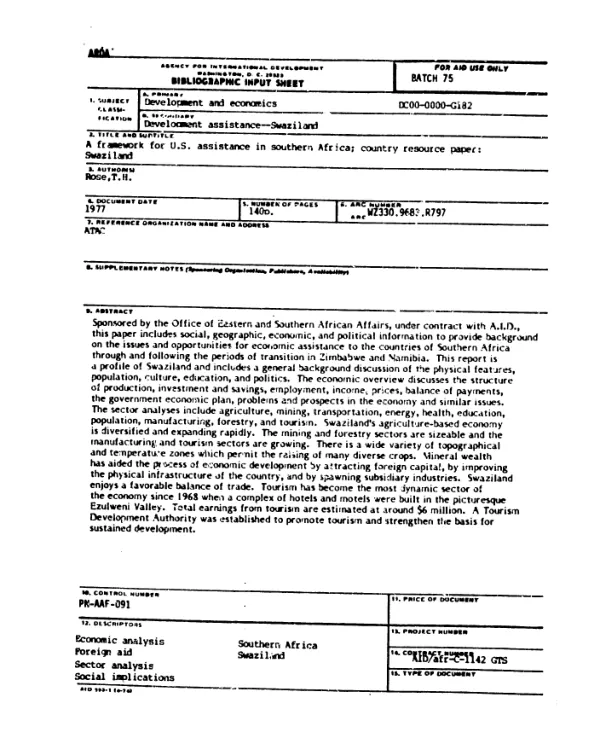
This paper includes social, geographic, economic, and political information to provide background on the issues and opportunities for economic assistance to the countries of Southern Africa through and following the periods of transition in Zimbabwe and Namibia.
Epstein, G. A. · 1970
Sign in to readA free account is required to download.
Abstract
This report is a profile of Botswana and includes a general background discussion on physical features, demography, culture, education and politics. An economic overview discusses economic structure, balance of payments, terms of trade, prices, planning, government budget, and general development problems. Sectoral analyses include agriculture, mining, transportation, energy, power and communications, health, education, population, industry and commerce. Since independence, Botswana"s economy has expanded with an increase in the Gross Domestic Project (GDP) of 20% at a compound annual rate. Major developments in mining, particularly in the last six years, and sizable increases in cattle production and prices during most of this period have been primarily responsible for the growth. The two major development problems facing Botswana are external over-dependence and uneven development. The government is planning to finish building and bituminizing a road to Zambia and is making long range plans to take over the Rhodesian owned and operated railroad running through its eastern region. It is attempting to diversify its sources of foreign capital and expertise. The government is instituting a radically new land use policy to stem the rapid deterioration of range lands. Studies are being generated on employment, migration, and an evaluation of the Accelerated Rural Development Program.