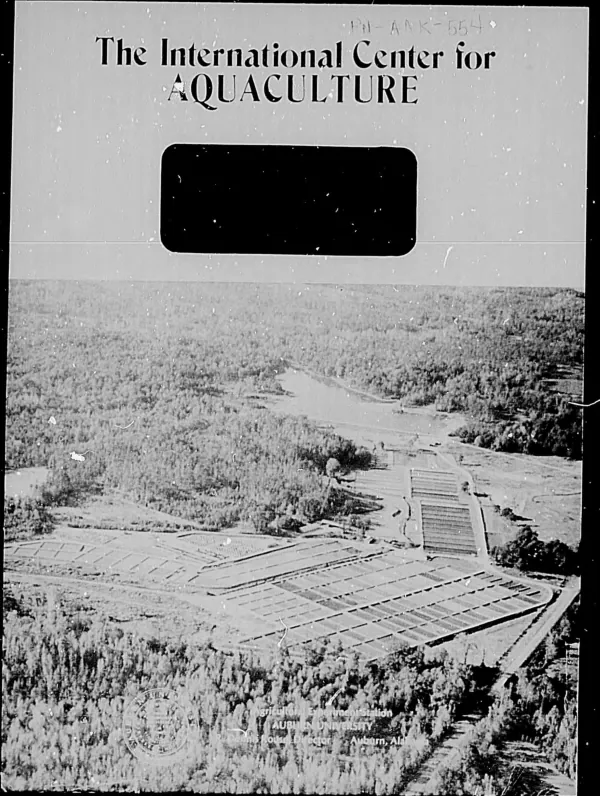
AUBURN UNIVERSITY. INTERNATIONAL CENTER FOR AQUACULTURE
Freshwater aquaculture development in Colombia : final report
Evaluates project to develop aquaculture on Colombia"s Magdalena River.
Phelps, Ronald P.; Popma, Thomas J. · 1970
Sign in to readA free account is required to download.
Abstract
Final contractor report covers the period 2/77-6/80. Despite inconsistent government support and construction delays, the project has shown success. A key achievement was the construction of two excellent aquaculture stations, one at warm water Repelon (where laboratory and living quarters will not be completed until 1980), the other at Alto Magdalena in the climatically moderate Gigante Region. Unfortunately, cost overruns, especially at Alto Magdalena (45%), forced cancellation of two planned biology stations. Technical work at Repelon focused on evaluating the potential of various species, especially those native to the region, for aquaculture development. Species were studied in terms of commercial acceptability, morphology, and fingerling availability. Preliminary studies showed Tilapia rendalli (TR), Tilapia nilotica (TN), and mojarra amarilla as the most promising. Monosex culture studies of TR and TN were also conducted. Two cichlids, TN and cachama, showed the best potential for intensive aquaculture. At Gigante, where the key aim was to develop technologies for private rural ponds, activity focused on the herbivorous cichlid TR. In both areas, predator-prey studies were made of mojarra amarilla and economic data were collected. Fifteen M.S. scholarships, 5 one-week in-country courses, and non-degree training in several Latin American countries were provided to Colombian biologists. As the first stage of a proposed national aquaculture plan, the project established aquaculture"s potential for fishery management in large reservoirs and for watershed management;small ponds and 5-10 ha reservoirs could be built and stocked in conjunction with reforestation. Other recommendations are to: improve financial support for research stations and logistical support for training efforts; complete facility construction; develop minimum management systems based on simple predator-prey combinations; conduct market studies; develop simultaneously both small- and medium-scale commercial aquaculture; intensify research into cool temperature applications; and integrate fish farming with other farming activities.