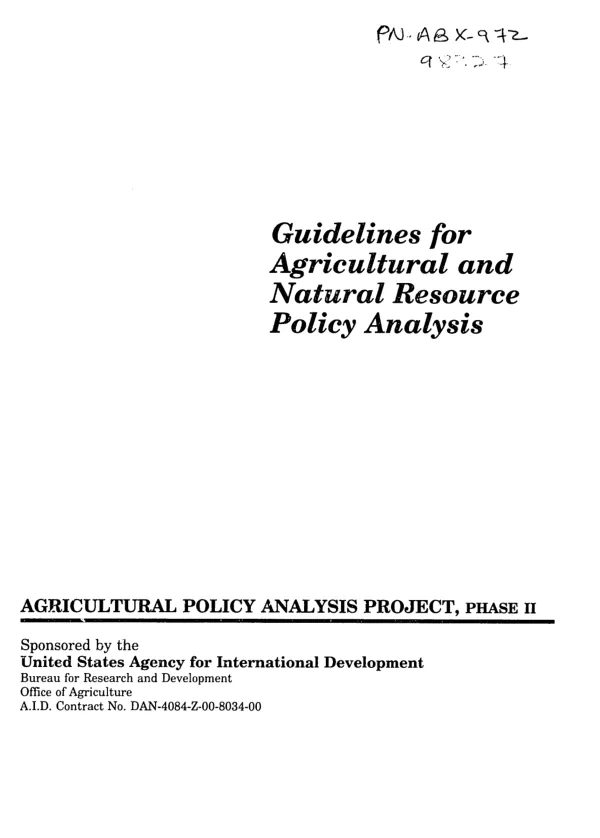
AUBURN UNIVERSITY. INTERNATIONAL CENTER FOR AQUACULTURE
Management of the Upper Meta River food - fish fishery
The Upper Meta River fishery is the most intensively exploited and most likely to be expanded fishery within Colombia"s Orinoco system.
Scully, Richard J.; Garzon F., Fernando · 1980
Sign in to readA free account is required to download.
Abstract
This report, the first of a three volume study, reviews fishery management in terms of catch assessment surveys to determine fishing effort and catch per unit effort (CPE); species composition and length frequency distributions (LFD) of the commerical catch; and the efficiency of fishing gear. CPE"s in commercial areas were found to be adequate to provide fishermen with a good income, with profits highest (3.8 times greater than needed to sustain a subsistence fishery) in the upper 100 km section due to its nearness to the Villavivencio and Bogota markets. Lack of a developed marketing system in the lower tributaries limits fishing to what is required for home consumption. Six of the 25 species in the commerical catch make up 80% of the annual harvest. Detailed analyses of LFD"s for these six species during the 1977-78 fishing season are provided; their value lies in interpreting population changes over time. Species characteristics presented in- clude maximum, minimum, and average size of the catch, season of abundance, size range by sex, stomach contents, length at maturity, and length-weight and length-length conversion equations. Gear most commonly used are single or multiple hook setlines and gill and cast nets, although the Cachamaro setline, the gear most commonly used, is also the least effective. Tables are presented showing the percent catch of each species by each gear. Almost all grill nets are of 20 cm stretched mesh, a size which selects for mature fish of most species. Results of experiments with other types of gear are presented. Recommendations include: allowing the use of gill nets with stretched mesh 18 cm in size, castnets of any mesh size, the harpoon and the bow and arrow, and the hand gaff; using data sheets to improve commerical catch statistics; using LFD"s to determine endangerment of any species; protecting endangered species; estimating the maximum sustainable yield of fishable stocks; protecting the ecosystem from dangers posed by agricultural practices in the Piedmont, fumigation, and pesticides; and accumulating further data, including economic data. Included are several substantive appendices, and a 22-item bibliography (1974-79).
Related documents