USAID DEC
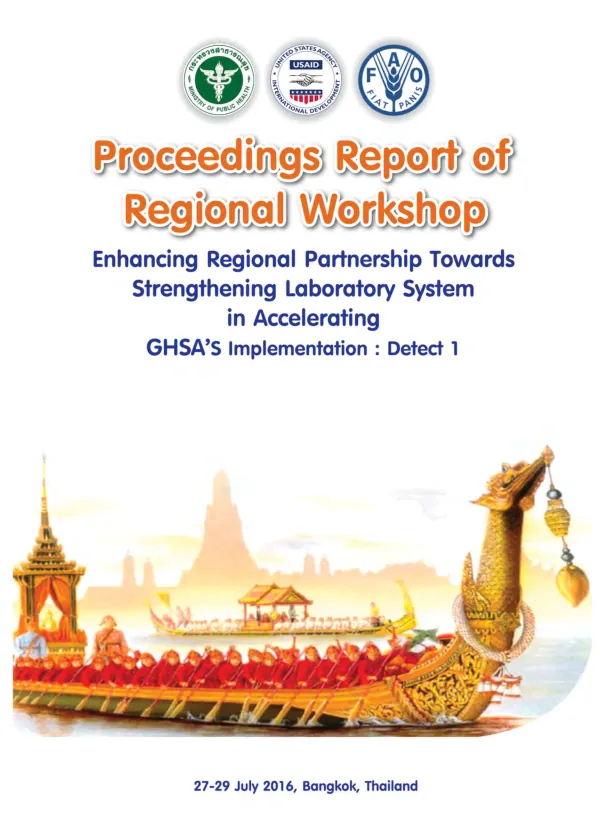
Proceedings Report of Regional Workshop: Enhancing Regional Partnership Towards Strengthening Laboratory System in Accelerating GHSA’s Implementation: Detect 1
Sign inJAPANESE AGENCY FOR INTERNATIONAL COOPERATION
Proceedings Report of Regional Workshop: Enhancing Regional Partnership Towards Strengthening Laboratory System in Accelerating GHSA’s Implementation: Detect 1
The Global Health Security Agenda (GHSA) is a global effort to accelerate progress towards a world safe and secure from infectious disease threats.
2017 · 115 pages
Sign in to readA free account is required to download.
Abstract
The GHSA aims to promote global health security as an international priority and spur progress towards the implementation of the World Health Organisation (WHO), International Health Regulations 2005 (IHR), and other relevant global health security frameworks. Thailand, through the Ministry of Public Health, has taken a leadership role in implementing the GHSA, particularly in the area of "Detect 1: National Laboratory System." This initiative aims to establish a national laboratory system that can provide real-time bio-surveillance and effective modern point-of-care and laboratory-based diagnostics. A regional workshop was convened in Bangkok, Thailand, from 27-29 July 2016, to enhance regional partnership towards strengthening laboratory systems in accelerating GHSA's implementation. The workshop was attended by representatives from 11 countries, including the 2016 GHSA Chair (Indonesia), Lead Countries and Contributing Countries of Detect 1, ASEAN, SAARC, Timor Leste, and key development partners. The workshop aimed to update national strategic plans on National Laboratory System Strengthening (LSS), present the Regional Strategic Roadmap on Laboratory System Strengthening (LSS), identify key regional activities, and enhance networking on LSS across regions. The event was a success, with participating countries acknowledging the importance of the GHSA as an enabling platform for leveraging and maximising existing efforts to strengthen national laboratory systems. Key tangible achievements from the workshop include the recognition of emerging and re-emerging diseases as major global health concerns, the acknowledgment of ongoing efforts by key development partners to strengthen national laboratory systems, and the development of the Strategic Roadmap of Laboratory System Strengthening (LSS, 2016-2020). The roadmap aims to follow up progress on the GHSA: Detect 1: National Laboratory System at national and regional levels. The workshop also highlighted the importance of collaboration and coordination among countries and development partners to strengthen laboratory systems and improve global health security. The event was a significant step towards achieving the GHSA's goals and objectives, and it is expected to have a positive impact on the implementation of the GHSA: Detect 1: National Laboratory System in the region. The GHSA: Detect 1: National Laboratory System initiative is a critical component of the GHSA, as it aims to establish a national laboratory system that can provide real-time bio-surveillance and effective modern point-of-care and laboratory-based diagnostics. The initiative is expected to improve the detection and response to infectious disease outbreaks, reduce the risk of disease transmission, and enhance global health security. The workshop's outcomes and recommendations are expected to guide the implementation of the GHSA: Detect 1: National Laboratory System in the region, and to inform the development of national strategic plans on National Laboratory System Strengthening (LSS). The event was a significant step towards achieving the GHSA's goals and objectives, and it is expected to have a positive impact on the implementation of the GHSA: Detect 1: National Laboratory System in the region.