USAID DEC
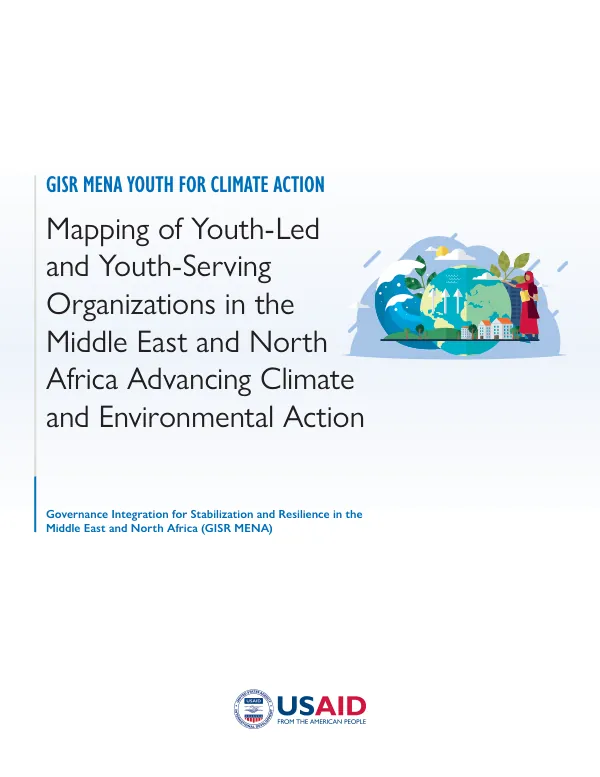
Mapping of Youth-Led and Youth-Serving Organizations in MENA Advancing Climate and Environmental Action
Sign inMANAGEMENT SYSTEMS INTERNATIONAL
Mapping of Youth-Led and Youth-Serving Organizations in MENA Advancing Climate and Environmental Action
The Middle East and North Africa (MENA) region is home to approximately 493 million people, with a growing importance of youth in addressing climate challenges.
2024 · 15 pages
Sign in to readA free account is required to download.
Abstract
Youth-led and youth-serving organizations are emerging as catalysts of transformation in the region, steering it toward a sustainable and resilient future. These organizations are at the forefront of addressing climate change and environmental challenges, with a primary focus on adapting to climate change impacts. Jordan, Lebanon, and Egypt emerged as hubs for climate-focused organizations, with variations in the prevalence of youth organizations. The primary focus of these organizations is adapting to climate change impacts, while Lebanon showed a particular emphasis on ecosystem protection. Notably, cross-regional collaborations underscored the importance of knowledge exchange in addressing shared environmental challenges. The analysis unveiled a nuanced picture of youth organizations engaged in climate action across the MENA region, with 48.9% identified as youth-led, 25.9% as youth-serving, and 25.2% identified as both. Among the 135 organizations mapped during the data collection process, there are distinct geographical distributions and thematic areas of focus. The distribution of organizations by type and country showed that Jordan, Lebanon, and Egypt emerge as leaders in representing both youth-led and youth-serving organizations dedicated to climate and environmental solutions. Lebanon has the highest number of youth-led organizations demonstrating its active youth engagement, while Egypt has a substantial presence of youth-serving organizations, possibly indicating a focus on education and awareness. The thematic areas of focus highlighted that adapting to the impacts of climate change is the primary focus of most youth organizations in the MENA region, suggesting a recognition of the urgent need to address climate-related challenges. Research and development in climate change is least prevalent, indicating potential areas for growth in scientific research and innovation. The analysis also showed that youth-led organizations primarily engage in adapting to the impacts of climate change, with significant representation in Jordan, West Bank and Gaza, and Iraq, underscoring their role in addressing regional climate resilience. Youth-serving organizations also play a crucial role in adapting to climate impacts, with a strong presence in Jordan, Morocco, and Egypt, highlighting their involvement in education and community support. Iraq is a notable hub for youth-serving organizations engaged in research and development in climate change, potentially contributing to scientific advancements in the region. Organizations that are both youth-led and youth-serving largely focus on adapting to climate change impacts, with Egypt, Jordan, and Lebanon taking the lead in this sector. To further support youth-led and youth-serving organizations in the MENA region, evidence-based recommendations offer guidance to stakeholders. Enhancing data collection and validation efforts is crucial, recognizing the significance of comprehensive and up-to-date data for informed decision-making. Investing in systematic data collection methodologies, including partnerships with local organizations and experts, can address data gaps in countries like Yemen. Fostering real-time monitoring and evaluation is also essential, developing mechanisms for ongoing monitoring and evaluation of youth organizations and implementing regular data validation processes to ensure the accuracy of information collected. Promoting cross-regional collaboration is also recommended, encouraging and facilitating cross-regional collaborations among youth-led and youth-serving organizations. Supporting initiatives that enable knowledge exchange, resource sharing, and joint advocacy efforts, particularly among countries facing similar environmental challenges, can help to advance the collective effort to tackle pressing climate and environmental challenges in the region.