USAID DEC
FY 2015 Q2 PROGRESS REPORT: Community Development Program for Caracol - EKAM Housing Project
Sign inGLOBAL COMMUNITIES
FY 2015 Q2 PROGRESS REPORT: Community Development Program for Caracol - EKAM Housing Project
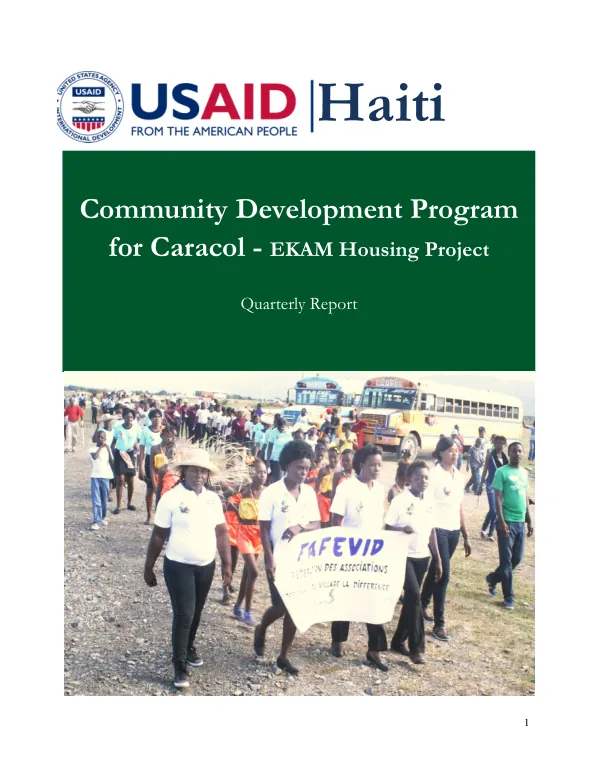
The Community Development Program for Caracol, also known as the EKAM Housing Project, is a USAID-funded initiative aimed at developing a sustainable social housing village in Haiti.
2015 · 10 pages
Sign in to readA free account is required to download.
Abstract
The program, implemented by Global Communities, began on August 7, 2013, and is scheduled to conclude on August 7, 2015. The program's primary objective is to create a self-sufficient community where residents, stakeholders, and partners have an equal sense of ownership. The program's focus shifted in the second quarter of fiscal year 2015 to resident capacity building and livelihood improvement. The Community Management Committee (CMC), with the assistance of community mobilizers, facilitators, and block captains, facilitated greater communication between residents and the administration. This increased transparency and interaction encouraged residents to pay their bills and start their own initiatives. Global Communities continued to support the EPPLS, the village management team, by motivating residents to pay their bills, improving security, evicting residents, and monitoring/evaluating the program. Despite challenges arising from the floods in November and December 2014, the program made significant progress. A community-based committee was organized to discuss solutions and preventative measures for natural disasters, and several plans were catalyzed. In the subsequent quarter, the CDP program intends to offer multiple trainings for women, residents, the EPPLS, and CMC. These trainings will provide technical, management, or livelihood skills to build the capacity of the social housing village at all levels. Key activities planned for the next quarter include supporting CMC activities, hosting PACE trainings, solving sewage and technical problems, offering women technical trainings, training residents on social integration, fostering public and private partnerships, improving livelihood opportunities, and continuing trainings for the EPPLS team and the CMC team. The move-in process for beneficiaries ended in February 2014, and the 63 houses reserved for students of the King Christophe's University have been occupied since November 2014. CDP outfitted the houses with gas stoves, and beneficiaries attended a training on the use of those stoves. The community mobilizers continued sensitizing residents to the concept of paid services, and a poster campaign was launched to encourage residents to pay their water bills. As a result, most residents paid at least one out of three months of bills, and the rent payments remained stable. Community meetings were held to inform block captains and facilitators about upcoming community activities, involve them in water payments, and sensitize them to the cleaning campaign during carnival. The block captains also met with representatives of the five women's organizations to exchange ideas, identify problems/solutions, and develop income-generating activities. Two-hour trainings were conducted twice a week by a mobilizer, focusing on social integration and the vision for the village after the departure of Global Communities. The CMC, CDP, and EPPLS members reflected on the previous quarter, focusing on achievements, challenges, and lessons learned. The evaluation of the program prompted activities for this quarter, including selecting market place beneficiaries, deciding on carnival activities, learning how to use the sound system, finalizing the legal status of the CMC, monitoring flood solutions, and planning elections. Conflicts and issues arose this quarter, including competition between neighbor stores, lack of cooperation between block captains and residents, and two rape attempts. Mobilizers quickly resolved the issues, and EPPLS trainings were supported and collaborated with by Global Communities. EPPLS communicated with CMC members, mobilized teams for rent and bill collection, supported initiatives, and participated in every meeting, event, and decision-making process.