GLOBAL COMMUNITIES
USAID/Haiti CDP PROGRAM PROGRESS REPORT FOR Q1 FY 2016
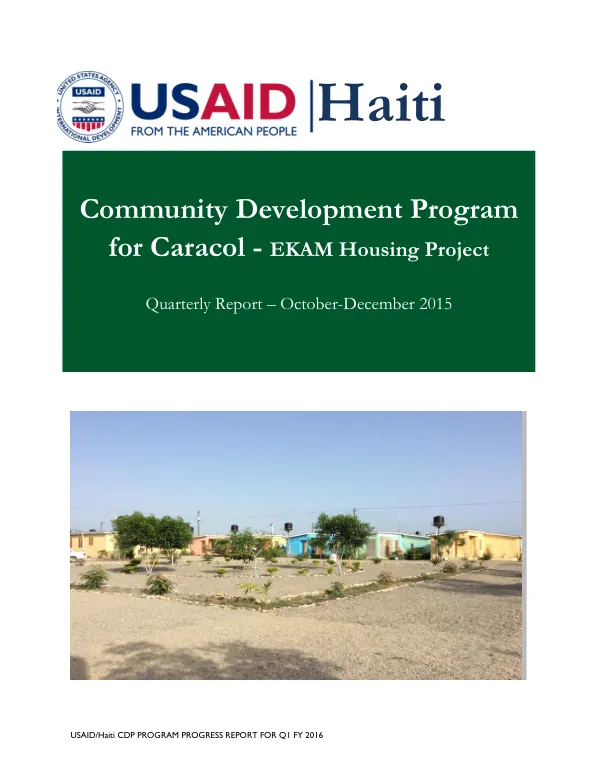
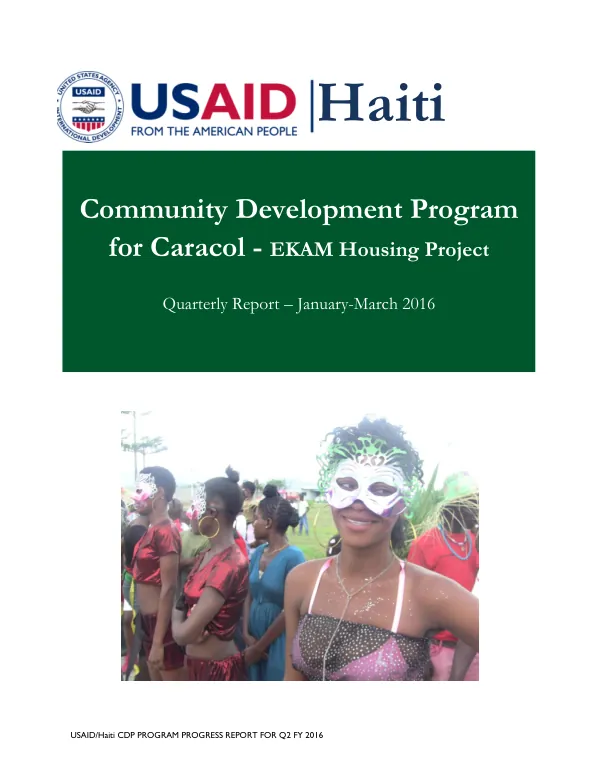
The Community Development Program for Caracol, also known as the EKAM Housing Project, is a USAID-funded initiative aimed at developing a sustainable social housing village in Haiti.
2016 · 8 pages
Sign in to readA free account is required to download.
Abstract
The program, implemented by Global Communities, focuses on empowering residents to take ownership of their community through various interventions. The program's qualitative summary highlights the importance of community engagement and participation in decision-making processes. Residents have been trained in WASH (water, sanitation, and hygiene) practices, and a Community Management Committee (CMC) has been established to oversee housing activities and represent residents' interests. The CMC has been responsible for planning and executing events, such as Carnival, and has developed a land-use plan to drive business and economic development in the village. Quantitative data from the quarter indicates significant progress in various areas. A total of 34 platform committees were renewed, with 7 residents elected to each committee. Additionally, 255 screenings for malnutrition were conducted, and 31 people were vaccinated, including 25 children. The distribution of Vitamin A and contraceptive methods also took place. The program has also made efforts to improve governance and community relations. Community mobilizers have been sensitizing residents to the concept of paid services, emphasizing the importance of timely payment of service fees to avoid eviction and disconnection of water services. As a result, 17.4% of residents paid their water bills on time and in full, compared to 29% in the previous quarter. The program has also focused on capacity building for the CAEPA staff, working with a new system to register payment of water bills that will provide quicker and more efficient access to information for the field team. Community meetings were held to sensitize residents about the election of platform committees, commissions, and CMC, highlighting the importance of being part of community structures and paying rent and water. In terms of operational support, Global Communities has collaborated with the EPPLS site team, providing training and support to EPPLS staff. Three trainees who trained on the site were recruited by EPPLS and have been involved in sensitizing residents to pay rent and serving as rent bill collectors. The program has also addressed conflicts and issues, with mobilizers and the security commission resolving three minor issues between neighbors. Site management and services have been maintained, with no evictions taking place this quarter, although the payment rate remained low due to the weakening national economy and political turmoil. Public spaces have been maintained, with the EPPLS truck collecting and removing trash from the village every day. Twenty-three residents who have difficulties paying their rent were recruited to remove trash, providing them with an opportunity to earn income. The program's subsequent quarter's work plan includes offering multiple technical trainings for residents, focusing on building their capacity in various areas, including clothing design and construction, social integration, and livelihood skills. Other key activities for the next quarter will include participatory action for community enhancement, improving livelihood opportunities, fostering public-private partnerships, solving sewage and technical problems, allocating a market space to selected entrepreneurs, and allocating a plot to individuals interested in building private houses.
![Home Ownership and Mortgage Expansion (HOME) Program Quarterly Report [Q2 FY 2016]](https://covers.devme.ai/gen/150276.webp)