GLOBAL CENTER FOR FOOD SYSTEMS INNOVATION
FY 2018 Mid-Year Report
The Global Center for Food Systems Innovation (GCFSI) at Michigan State University (MSU) continued implementing select projects and activities during the reporting period, October 2017 through March 2018.
2018 · 69 pages
Sign in to readA free account is required to download.
Abstract
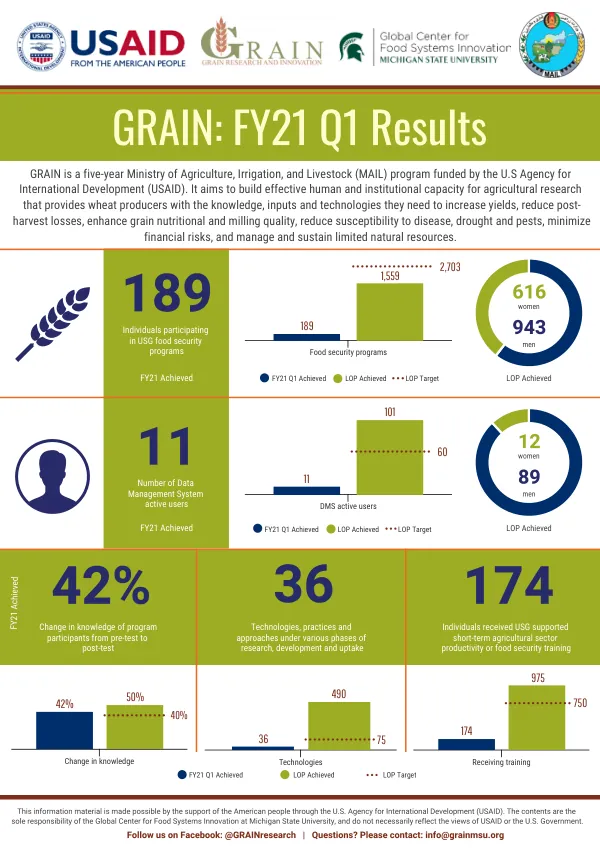
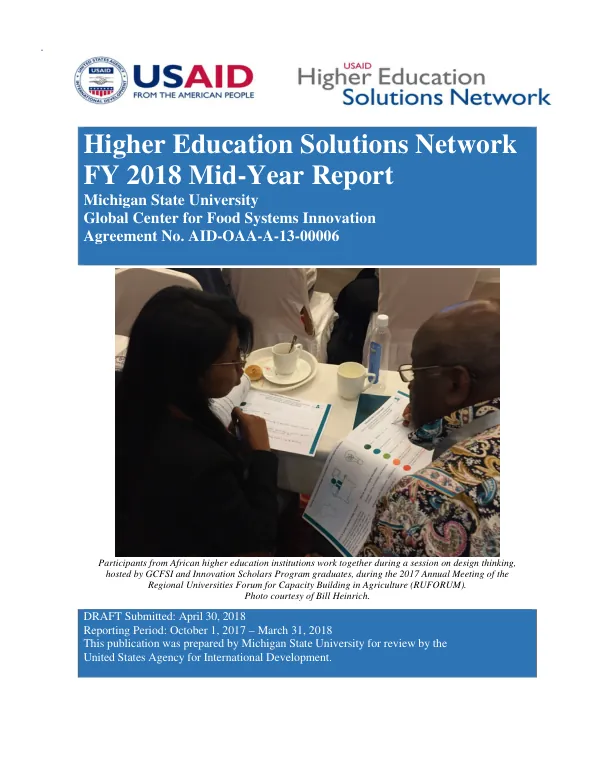
GCFSI organized a design-thinking workshop, led by graduates of the Malawi Innovation Scholars Program (ISP), during the annual meeting of the Regional Universities Forum for Capacity Building in Agriculture (RUFORUM) in Lilongwe, Malawi. The workshop provided an opportunity for ISP scholars to teach others about their experiences and knowledge gained over the prior 15 months. GCFSI also submitted a proposal for a second iteration of the ISP to USAID in response to the Science, Technology, and Innovation Partnerships Annual Program Statement (STIP/APS), released in March 2018. Several RUFORUM universities expressed interest in having an ISP-type program for their institutions, and GCFSI is working with these institutions to secure funding. The city-regional food system program, represented by the work associated with the Frugal Innovation Practicum and Lilongwe food market research, was awarded $7,000 by the Center for Gender in a Global Context and an expected $6,200 by the Center for Advanced Study of International Development at MSU. The funds will be used to host a partner and stakeholder collaborative strategy development workshop in Lilongwe in August 2018. Three separate departments at MSU have pledged to contribute 20% of the travel costs of the MSU faculty attending the workshop. Two research briefs focused on city-regional food systems research have been produced in collaboration with MSU's Center for Regional Food Systems. During this period, all GCFSI-funded innovation grantees are in the process of ending their field activities and writing final reports. GCFSI has received final reports from the teams working on several projects, including coconut value chain improvement via Farmerlink, anaerobic digestion series of innovations, SoilDoc + Climate app, cassava simulation model, and low-carbon cool storage. Through the Grain Research and Innovation (GRAIN) buy-in from USAID/Afghanistan, GCFSI facilitated the recruitment and selection of over 20 Afghan women and men into a Doctoral and Master's Degree Scholarships Program that will start in Fall 2018. The GRAIN team initiated wheat breeding trials in collaboration with the International Center for Agricultural Research in the Dry Areas (ICARDA), and additional agronomy trials were started at the Agricultural Research Institute of Afghanistan (ARIA) and university research sites in six provinces. GRAIN also navigated substantial personnel changes and made hires as appropriate, including the Gender and Social Inclusion Advisor, Communications and Outreach Director, Program Manager, and Northern Region Manager. The Deputy Chief of Party (DCOP) was promoted to Chief of Party, and the search for a replacement DCOP is underway. The Innovation Scholars Program (ISP) hosted two major events in Malawi in October 2017. The first event was a graduation program for the ISP scholars on the Lilongwe University of Agriculture and Natural Resources (LUANAR) campus. The second event was a workshop on design thinking and transformative leadership led in large part by three ISP graduates during the annual meeting of RUFORUM. As a result of this workshop, GCFSI is working with RUFORUM to have a specific part of the agenda for the upcoming RUFORUM Bi-Annual Meeting. GCFSI has been awarded $7,000 by the Center for Gender in a Global Context and an expected $6,200 by the Center for Advanced Study of International Development at MSU to host a partner and stakeholder collaborative strategy development workshop in Lilongwe in August 2018. The workshop will bring together partners and stakeholders to develop a collaborative strategy for the city-regional food system program. The funds will also be used to support the travel costs of MSU faculty attending the workshop. The city-regional food system program is a key area of focus for GCFSI, and the workshop will provide an opportunity for partners and stakeholders to come together and develop a collaborative strategy for the program. The program aims to improve food security and nutrition in urban and peri-urban areas through the development of sustainable and resilient food systems. The workshop will bring together experts from academia, government, and the private sector to share knowledge and expertise and develop a collaborative strategy for the program. GCFSI has also been working with RUFORUM universities to establish ISP-type programs for their institutions. Several RUFORUM universities have expressed interest in having an ISP-type program, and GCFSI is working with these institutions to secure funding. The ISP-type program will provide opportunities for students and faculty to develop skills and knowledge in areas such as design thinking, transformative leadership, and innovation. The Grain Research and Innovation (GRAIN) team has been working on several projects, including wheat breeding trials in collaboration with the International Center for Agricultural Research in the Dry Areas (ICARDA). The team has also initiated additional agronomy trials at the Agricultural