INTERNEWS
FY2015 Annual Report: Strengthening Free and Independent Media in South Sudan
The i-STREAM program is a USAID-funded project aimed at strengthening the independent media sector in South Sudan.
2015 · 96 pages
Sign in to readA free account is required to download.
Abstract
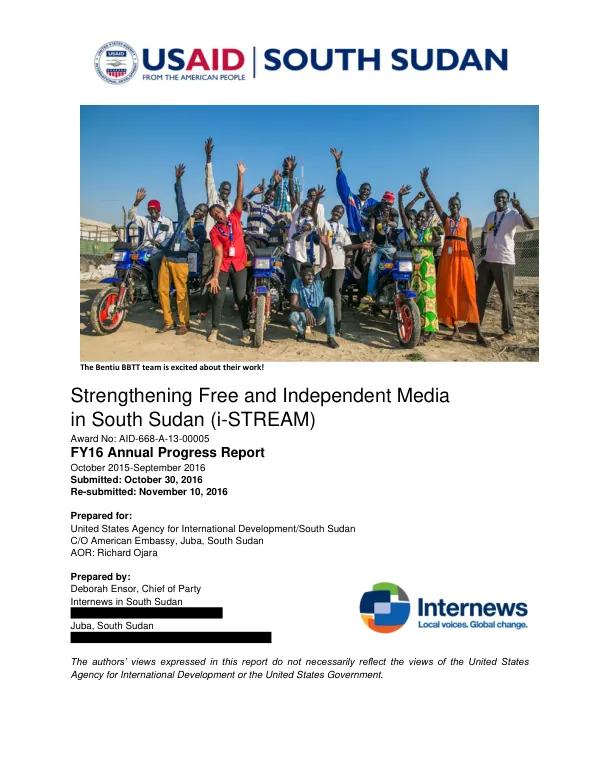
The five-year, $75 million program seeks to strengthen a free and independent media in South Sudan, with an emphasis on the independent radio sector. The program's goal is to support the transition to self-sustainability of five currently funded USAID-supported local partner radio stations and improve the professional preparation of journalists, the economic self-sustainability of media houses, the enabling environment for a free media, and the support institutions for a freer media. The program views media development as a holistic process that encompasses several key interlinking factors, including the production and distribution of quality content, the financial sustainability of media outlets, a fair and predictable legal environment, and the existence of strong support institutions. When the current 5-year i-STREAM project was awarded in October 2013, Internews was operating five stations supported by USAID, including Eye Radio in Juba, Central Equatoria state, and four community radio stations in Warrap, Unity, Upper Nile, and Northern Bahr el Ghazal states. However, just months after the project began, serious conflict erupted in South Sudan. The conflict, which started on December 15, 2013, between factions loyal to President Salva Kiir and those aligned with his former Vice President, Riek Machar, has had a devastating impact on the country, causing the internal displacement of almost 2 million people, the deaths of tens of thousands, and a food crisis of epic proportion. Despite the conflict, Internews maintained and even ramped up broadcasting at all five stations, providing a critical service to the people of South Sudan. The program has also established four Humanitarian Information Services (HIS) - called Boda Talk (BBTT) - in Juba, Malakal, and Bor, and two mobile "radio-in-a-box" stations in Mingkaman and Malakal, specifically serving internally displaced peoples (IDPs). The community stations, HIS, and the mobile radio stations have a combined total audience of up to one million and are now the most trusted source of information in their communities. The i-STREAM approach recognizes that these efforts do not take place in a vacuum and can only fully succeed when linked to the wider media climate. The program also recognizes the importance of not just providing support to targeted outlets but also ensuring that the sector as a whole, including individual journalists at risk, receives the attention it needs to protect members of its community and empower them to serve their audiences safely and with credibility. As such, activities in FY2015 included a suite of activities addressing the media laws, security of journalists, extensive research on the sector, and a robust small grants program which supports the development of the media sector in South Sudan. The program's objectives include strengthening autonomous, journalistic professionalism and facilitating the development of an institutionally well-managed and financially self-sustained, independent media in South Sudan. The program also aims to promote a freer and open media environment through improving the normative-legal-regulatory conditions and supporting media institutions. Additionally, the program seeks to more effectively South Sudanese media capacities to raise the quality, quantity, and self-sustainability of development communications by the South Sudanese media across democracy-building, peace, economic growth, social, health, and other key issues. The program's progress is measured through a set of indicators, including the growth and support of Eye Media, the partnership with the University of Juba, and activities around media law and regulation. The program has made significant progress in achieving its objectives, including the establishment of four Humanitarian Information Services and two mobile "radio-in-a-box" stations, which have a combined total audience of up to one million. The program has also provided critical services to the people of South Sudan during the conflict, maintaining and even ramping up broadcasting at all five stations.