SOCIAL IMPACT, INC.
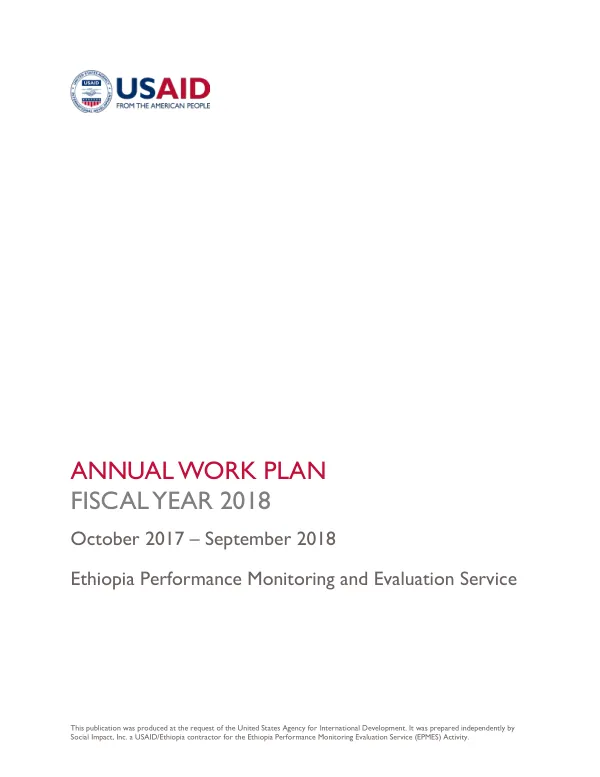
FY2018 ANNUAL WORK PLAN, EPMES
The Ethiopia Performance Monitoring and Evaluation Service (EPMES) Activity is a four-year program aimed at providing project/activity external evaluation, performance monitoring, and performance management support services to USAID/Ethiopia.
2018 · 48 pages
Sign in to readA free account is required to download.
Abstract
The program is designed to assist USAID/Ethiopia and its partners in generating empirical data on project/activity implementation and fostering learning and knowledge management to improve evidence-based project design and development programming in support of the Country Development and Cooperation Strategy (CDCS). The EPMES Activity is implemented by Social Impact, Inc. (SI) in partnership with Sub-Saharan Africa Research and Training Center (SART), PRIN International Consultancy & Research Services, and Information Systems Services (ISS-Ethiopia). The program's main services include external evaluations as requested by USAID, management and monitoring and evaluation (M&E) technical capacity building for implementing partners (IPs), select local organizations, and Mission staff, and support to technical offices to analyze geo-referenced data. The EPMES Activity is guided by the USAID Automated Directives System (ADS) and Evaluation Policy. The program's objectives are to provide high-quality evaluation and M&E services to USAID/Ethiopia, strengthen the capacity of implementing partners and local organizations, and support the development of evidence-based project design and development programming. The EPMES Activity is funded by USAID and has a budget of $16,658,919.89 for the four-year period. The program's planning period is from October 1, 2017 to September 30, 2018. The EPMES Activity is expected to contribute to the achievement of the Country Development and Cooperation Strategy (CDCS) goals and objectives. The EPMES Activity will implement three main objectives: (1) Provide external evaluation services, including impact and performance evaluations, assessments, and studies; (2) Provide performance monitoring technical support services to the Mission to strengthen evidence-based decision making; and (3) Improve and enhance the capacity for learning and adapting within USAID/Ethiopia throughout the project cycle. The EPMES Activity will also support the host-country M&E capacity strengthening and provide other deliverables, including a Monitoring, Evaluation, and Learning (MEL) Plan, Quarterly Progress Reports, and an Annual Progress Report. The program will utilize the EQUI Approach for USAID/Ethiopia evaluations and studies and will interact with USAID to ensure alignment with USAID's policies and procedures. The EPMES Activity will also conduct an organizational review and learning from FY17 to identify areas for improvement and to develop strategies for capacity building and knowledge management. The program will also provide training and technical assistance to USAID/Ethiopia staff and implementing partners to enhance their capacity for learning and adapting. The EPMES Activity will be implemented in partnership with various stakeholders, including USAID/Ethiopia, implementing partners, local organizations, and local government institutions. The program will also collaborate with other USAID-funded projects and activities to ensure alignment and coordination of efforts. The EPMES Activity will be monitored and evaluated regularly to ensure that it is meeting its objectives and to identify areas for improvement. The program will also conduct a midterm evaluation to assess its progress and to identify areas for improvement. The EPMES Activity is expected to contribute to the achievement of the Country Development and Cooperation Strategy (CDCS) goals and objectives and to improve the quality of project design and development programming in support of the CDCS. The program will also enhance the capacity of implementing partners and local organizations for learning and adapting and will support the development of evidence-based project design and development programming.