USAID DEC
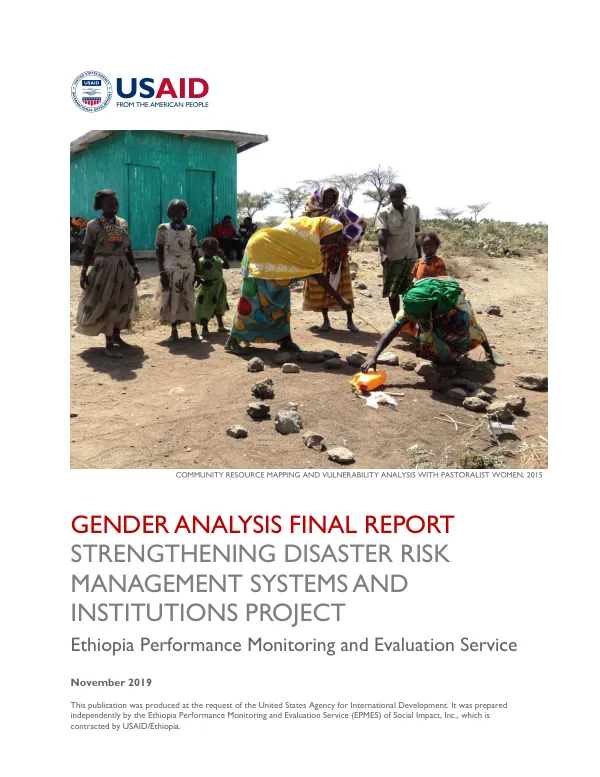
Gender Analysis Final Report: Strengthening Disaster Risk Management Systems and Institutions Project
Sign inSOCIAL IMPACT, INC.
Gender Analysis Final Report: Strengthening Disaster Risk Management Systems and Institutions Project
The Strengthening Disaster Risk Management Systems and Institutions Project in Ethiopia aims to enhance the capacity of institutions and communities to effectively manage disaster risks.
2019 · 22 pages
Sign in to readA free account is required to download.
Abstract
As of March 2019, the project's preliminary purpose is to strengthen the capacity of institutions and communities to manage disaster risks, contributing to the United States Agency for International Development's (USAID) Mission in Ethiopia's 2019-2024 Country Development and Cooperation Strategy (CDCS). The project's design focuses on building resilience as a component of both recovery and preparedness, emphasizing the potential contributions of women as actors rather than passive victims. The project will address gaps in participation by gender, which may affect key results, and identify potential priority areas for intervention based on key inequalities among genders. The gender analysis was conducted to provide pertinent information for the USAID/Ethiopia Strengthening DRM Design Team to enable gender integration within the project design and its Project Appraisal Document (PAD). The analysis identified design priorities and considerations for the project, addressing issues such as gaps in participation by gender, potential priority areas for intervention, and potential risks and differential effects with approaches provided for mitigation or monitoring. The gender analysis team used two primary data collection methods: a desk review of secondary sources containing qualitative and quantitative data and stakeholder consultations. The desk review involved a review of key documents on gender with regards to disaster risk management, supplemented by references or bibliographies in reports reviewed and stakeholder recommendations. Stakeholder consultations were held with purposively identified stakeholders based on their knowledge of the project's key themes or areas of interest. The project's geographic focus is on Ethiopia, with a specific emphasis on the Oromia region, which is switching to a commission-based disaster risk management system. The project's timeframes are not explicitly stated, but it is mentioned that the project design plan was completed in March 2018, and the project is expected to contribute to the USAID/Ethiopia's 2019-2024 CDCS. The project's implementation details are not explicitly stated, but it is mentioned that the project will contribute to the development of robust and inclusive response systems in a highly disaster-prone region. The project's recommendations and design implications are redacted from the report due to procurement sensitivity concerns. The project's findings highlight the importance of addressing gaps in participation by gender, which may affect key results, and identifying potential priority areas for intervention based on key inequalities among genders. The project's recommendations and design implications are expected to inform the project's design and implementation, ensuring that the project is inclusive and effective in addressing disaster risk management in Ethiopia.
Related documents