CHEMONICS
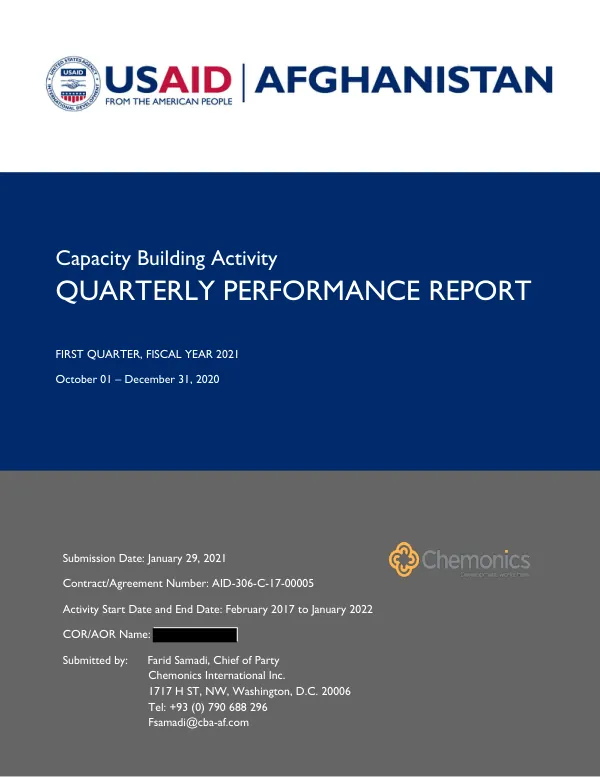
FY21 Q1 Performance Report
Capacity Building Activity in Afghanistan began in February 2017 and is scheduled to conclude in January 2022.
2021 · 41 pages
Sign in to readA free account is required to download.
Abstract
The program is implemented by Chemonics International Inc. and is funded by the United States Agency for International Development (USAID) through contract AID-306-C-17-00005. The primary counterpart organization is the Afghanistan Ministry of Education. The program's geographic coverage includes central Afghanistan and six provinces: Badghis, Balkh, Bamyan, Kandahar, and Paktia. The reporting period for this quarterly performance report spans October 1 to December 31, 2020. The program's overall objective is to strengthen the capacity of the Ministry of Education to manage and deliver education services effectively. During the first quarter of fiscal year 2021, the program focused on several key activities. In the education management information system (EMIS) component, data quality assessments were conducted, and intermediate and advanced-level data analysis trainings were provided to education officials. An EMIS pilot program was also implemented in 15 communities, resulting in a 60% yield improvement when applying recommended sustainable agriculture practices. In the teacher recruitment component, data cleaning and verification of digitized Sawaneh were completed, and job descriptions were developed and standardized. Sawaneh and PRIS data analysis was also conducted, and English and computer courses were provided to teachers. Trainings and on-the-job training (OJTs) were conducted for teachers, with a focus on improving their skills and knowledge. The payroll systems component involved generating tax identification numbers, adding a payroll page to the Ministry of Education's webpage, and implementing a payroll quality assurance program. The PRIS database was modified, and payroll reporting was conducted. Trainings and OJTs were also provided to payroll staff to improve their skills and knowledge. In the internal audit component, performance improvement support was provided, and fraud prevention and anti-corruption awareness training was conducted. Regular audit training was also provided, and planned internal auditing OJTs were conducted. The resource planning, allocation, and execution component involved output-based budgeting support, financial management manual training, and the extension of AFMIS coverage to provincial education directorates. The civil society oversight component involved information sharing policy development assistance, EMIS data verification by civil society organizations, and support in the implementation of an anti-harassment policy through civil society organizations. Provincial peace dialogues were also organized, and public awareness messages were developed and disseminated. Cross-cutting activities included gender integration and gender equity, grants management, and coordination. Implementation challenges faced by the program included security challenges and the COVID-19 pandemic. The program's planned activities for the next quarter include continuing to implement the EMIS pilot program, providing trainings and OJTs to teachers and payroll staff, and conducting internal audits. The program's progress against performance indicators is being closely monitored, and the results framework is being used to track progress and identify areas for improvement. The program's overall goal is to strengthen the capacity of the Ministry of Education to manage and deliver education services effectively, and to improve the quality of education in Afghanistan.
Related documents