CHEMONICS
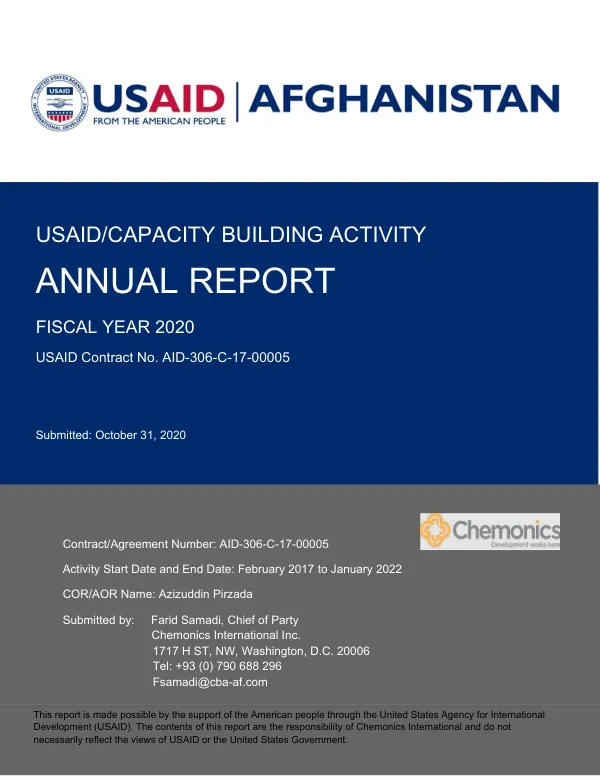
USAID/CAPACITY BUILDING ACTIVITY ANNUAL REPORT FISCAL YEAR 2020
The USAID/Capacity Building Activity in Afghanistan began in February 2017 and concluded in January 2022.
2020 · 77 pages
Sign in to readA free account is required to download.
Abstract
The activity aimed to strengthen the capacity of the Ministry of Education (MOE) to manage education services effectively. The project was implemented by Chemonics International, with Azizuddin Pirzada serving as the Contracting Officer's Representative (COR) and Farid Samadi as the Chief of Party. The project focused on several key areas, including education management information systems, teacher recruitment, payroll systems, internal audit, and resource planning. In the area of education management information systems, the project implemented an Education Management Information System (EMIS) database and interface enhancements, which included training for school representatives and data quality assessments. The project also conducted basic, intermediate, and advanced level data analysis trainings, and piloted an EMIS program in several communities. In the area of teacher recruitment, the project implemented a workforce planning policy and guideline training, digitized employee records, and conducted data analysis on teacher recruitment and retention. The project also developed job descriptions and standardized them, developed a database and reporting module for employee records, and conducted data cleaning and verification of digitized employee records. The project also focused on payroll systems, including national data cleaning and verification, tax identification numbers generation, electronic fund transfer awareness campaigns and training, and payroll quality assurance programs. In addition, the project established a quality assurance unit, conducted internal audit standards training, and provided regular audit training. The project also implemented a resource planning, allocation, and execution component, which included extending the coverage of the Afghanistan Financial Management Information System (AFMIS) to provincial education departments, providing support for output-based budgeting, and leveraging internal resources to build resiliency. The project also analyzed the MOE's FY19 budget report and provided OJTs (on-the-job training) to project staff. In the area of civil society organization (CSO) oversight, the project implemented provincial oversight public forums, completed three provincial CSOs capacity building grants, produced a short documentary video, and developed an information sharing policy. The project also conducted EMIS data verification by CSOs and CEMs (community education managers), installed information notice boards and suggestions boxes in schools, and conducted workshops on CSO oversight guidelines and MOE Shura management staff. The project's activities were implemented in several provinces across Afghanistan, with a focus on improving education services and increasing access to education for all Afghans. The project's achievements were significant, with notable improvements in education management information systems, teacher recruitment, and payroll systems. The project also made significant contributions to the development of CSO oversight and resource planning, allocation, and execution.
Related documents