USAID DEC
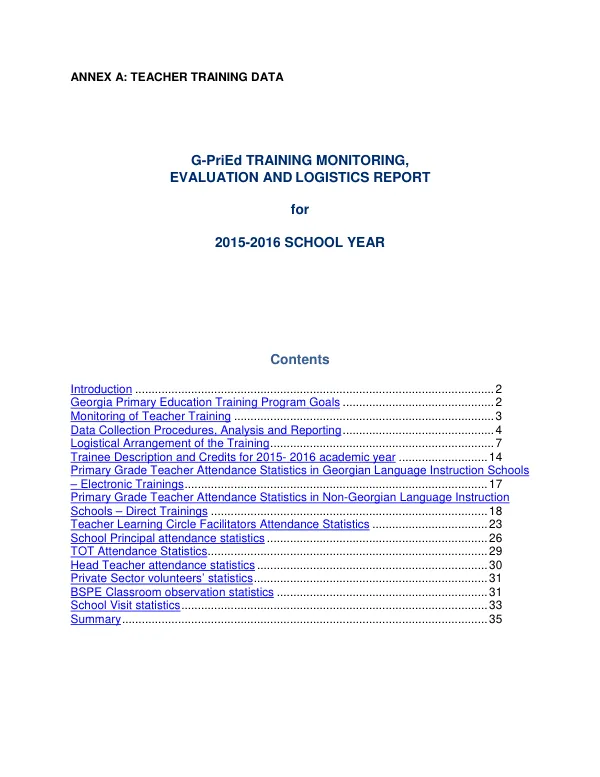
G-PriEd TRAINING MONITORING, EVALUATION AND LOGISTICS REPORT for 2015-2016 SCHOOL YEAR
Sign inMINISTRY OF EDUCATION AND CULTURE
G-PriEd TRAINING MONITORING, EVALUATION AND LOGISTICS REPORT for 2015-2016 SCHOOL YEAR
The Georgia Primary Education Training Program (G-PriEd) is a comprehensive assistance initiative to improve the reading and math competencies of Georgian and ethnic minority students.
2016 · 36 pages
Sign in to readA free account is required to download.
Abstract
The program, implemented in collaboration with the Ministry of Education and Science (MES), focuses on student-centered instructional strategies and school-based continuous professional development. G-PriEd's Business Skills in Primary Education (BSPE) component introduces age-appropriate business skills, such as entrepreneurship, financial literacy, and work readiness, to students in grades 1-6. The program's primary goals include improving classroom instruction in math and reading, strengthening the quality of reading and mathematics instruction, and enhancing pedagogical content knowledge in mathematics and language instruction. To achieve these objectives, G-PriEd offers professional development training for Grade 1-6 teachers, with a focus on strengthening the quality of reading and mathematics instruction, improving teachers' attitudes towards reading and mathematics, and enhancing pedagogical content knowledge in mathematics and language instruction. G-PriEd's training program features a school-based professional model that promotes close teacher collaboration for better student results. The program introduces subject-based Teacher Learning Circles (TLC) that are led by TLC facilitators, who are trained and mentored by G-PriEd. School principals are also targeted for training to ensure that instructional changes take place. Approximately 100 national trainers received training of trainer (TOT) training in various topics, including TLC facilitation, parental engagement, electronic training management, principal trainings, and classroom observation and teacher feedback techniques. The program's monitoring and evaluation unit ensures the high quality of training delivery and follow-up activities at all levels of project interventions. G-PriEd's M&E unit, together with technical staff, established quality indicators for successful training delivery and designed multiple data-collection tools to collect evidence on various aspects of training results. The program collects data on primary grade teacher attendance at e-training, teacher knowledge after training, teachers' performance at the classroom level, and observation of classroom practices. G-PriEd's electronic training program, launched on the Portal, enables the technical team to monitor school and each teacher's performance and take corrective measures if necessary. The Portal tracks e-session attendance information for each individual teacher, making it possible to monitor teacher attendance and participation in e-trainings. The program's data collection procedures and analysis enable G-PriEd to assess the effectiveness of the training program and make necessary adjustments to improve instructional delivery.