USAID DEC
Galvanizing Service Providers to Create Effective Referral Networks: Stakeholder Meetings
Sign inFHI 360
Galvanizing Service Providers to Create Effective Referral Networks: Stakeholder Meetings
Stakeholder meetings bring together diverse groups of health and ES/L/FS service providers, as well as key government representatives who could champion referral efforts long-term.
2015 · 2 pages
Sign in to readA free account is required to download.
Abstract
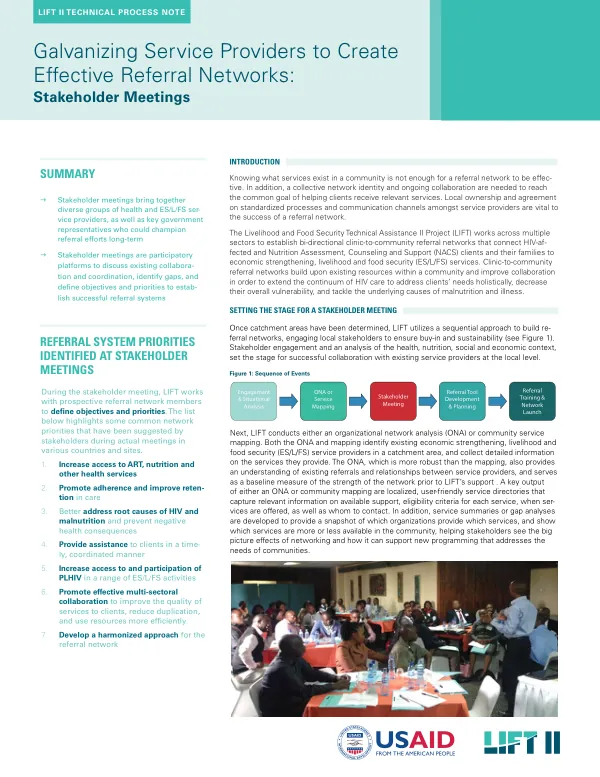
These meetings are participatory platforms to discuss existing collaboration and coordination, identify gaps, and define objectives and priorities to establish successful referral systems. Knowing what services exist in a community is not enough for a referral network to be effective. A collective network identity and ongoing collaboration are needed to reach the common goal of helping clients receive relevant services. Local ownership and agreement on standardized processes and communication channels amongst service providers are vital to the success of a referral network. The Livelihood and Food Security Technical Assistance II Project (LIFT) works across multiple sectors to establish bi-directional clinic-to-community referral networks that connect HIV-affected and Nutrition Assessment, Counseling and Support (NACS) clients and their families to economic strengthening, livelihood and food security (ES/L/FS) services. Clinic-to-community referral networks build upon existing resources within a community and improve collaboration in order to extend the continuum of HIV care to address clients' needs holistically, decrease their overall vulnerability, and tackle the underlying causes of malnutrition and illness. LIFT utilizes a sequential approach to build referral networks, engaging local stakeholders to ensure buy-in and sustainability. This approach includes engagement and situational analysis, ONA or service mapping, stakeholder meeting, referral tool development and planning, referral training and network launch. The stakeholder meeting is a critical component of this process, bringing together service providers and government representatives to share, validate, and solicit feedback on ONA/mapping results, jointly develop priorities for improving linkages between clinical and community ES/L/FS services, and decide on key action items and next steps to develop the referral network. During the stakeholder meeting, LIFT works with prospective referral network members to define objectives and priorities. Common network priorities include increasing access to ART, nutrition and other health services, promoting adherence and improving retention in care, better addressing root causes of HIV and malnutrition, and providing assistance to clients in a timely, coordinated manner. LIFT also leads stakeholders through activities to help them understand the need for client assessment and categorization, thereby assessing their demand for different ES/L/FS services, and using this assessment to match clients with the most appropriate ES/L/FS support available. Through experience, LIFT has adapted the stakeholder meeting format and planning in a number of ways to address lessons learned. These adaptations include helping organizations select the most appropriate participants, applying adult learning principles, enhancing the participatory nature of the meeting, and identifying a task force to keep the momentum going and work with LIFT to implement the action items. LIFT guides participants as they define the action items needed to meet objectives and launch an effective referral network, providing technical assistance in a range of areas, including political support, resources, coordination and leadership, tool development, data collection, and capacity development.